
Finding the right aquarium heaters for small tanks is harder than most beginners expect. A heater that is too weak can leave the water unstable, while one that is too powerful can create temperature swings that stress fish.
For most 5, 10, and 20-gallon tanks, we recommend a compact adjustable heater because it gives you much better temperature control than a basic preset model. If you keep a betta, shrimp, or other small tropical fish, that extra control can make a noticeable difference.
In this guide, we’ll compare the aquarium heaters we think are the best fit for small freshwater tanks, explain what size heater you actually need, and help you choose a reliable option without overspending.
Quick Answer
For most small freshwater aquariums, an adjustable aquarium heater is a practical choice because you can fine-tune the temperature rather than relying on a fixed preset.
As a starting point:
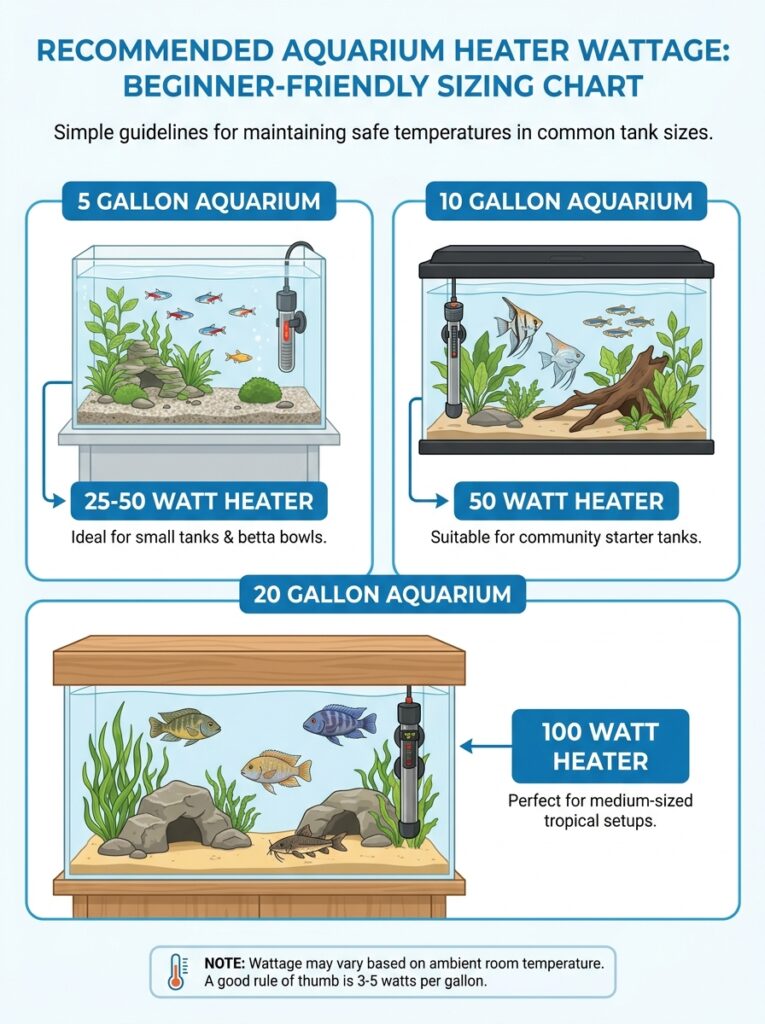
- 5-gallon tank: Look for a heater rated specifically for small tanks, often around 25–50W depending on the model and room temperature.
- 10-gallon tank: A 50W adjustable heater is a common starting point.
- 20-gallon tank: A 75–100W heater may be appropriate, depending on room temperature and the manufacturer’s recommendation.
The exact wattage is only part of the decision. Choose a heater that is properly rated for your aquarium and room conditions, check the manufacturer’s recommended tank range, and use a separate aquarium thermometer to verify the actual water temperature.
Below, we’ll compare the main heater options and explain which type makes the most sense for different small-tank setups.
Our Top Picks for 2026
If you want a quick starting point, these are the heater options we think are worth considering for beginner freshwater aquariums.
| Best For | Heater | Tank Size |
|---|---|---|
| Best Overall | Hygger Adjustable Aquarium Heater | 5–20 gallons |
| Best Budget | Tetra HT Submersible Preset Heater | 5–10 gallons |
| Best for Betta Tanks | Hygger Adjustable Aquarium Heater | 5–10 gallons |
| Best for 20-Gallon Tanks | hygger Small Aquarium Betta Heater, 100W with LED Digital Display | 15–20 gallons |
These picks reflect the factors that matter most when choosing a small aquarium heater: tank-size compatibility, temperature control, manufacturer-listed features, ease of use, and suitability for beginner setups.
Because room temperature and individual aquarium conditions can affect heating performance, always check the manufacturer’s specifications for the exact model and use a separate aquarium thermometer to verify the actual water temperature.
- Our Top Picks for 2026
- Why Stable Water Temperature Matters
- What Size Heater Do You Need for a Small Aquarium?
- ⭐ Best Overall: Hygger Adjustable Aquarium Heater
- What Most Beginners Actually Need
- Adjustable vs Preset Heaters
- ⭐ Best Budget: Tetra HT Submersible Preset Heater
- ⭐ Best for 20-Gallon Tanks: hygger 100W Small Aquarium Heater
- Which Aquarium Heater Should You Buy?
- How We Chose These Heaters
- Best Heater Choices for Common Small Aquariums
- How to Set Up an Aquarium Heater Safely
- Common Heater Mistakes Beginners Make
- ⭐ Helpful Add-On: Digital Aquarium Thermometer
- Conclusion
- FAQs
As an Amazon Associate, PetYeti earns from qualifying purchases. This comes at no additional cost to you and helps support the site.
Our recommendations are based on the product’s stated specifications, recommended aquarium sizes, features, ease of use, and suitability for the types of small aquarium setups discussed in this guide. We do not claim to have personally tested every product listed, so we encourage you to check the manufacturer’s specifications before purchasing.
In this guide, we’ll explain how aquarium heaters work, what size heater your tank actually needs, and how to choose a reliable option for small aquariums.
Many beginner fishkeepers spend hours choosing fish, plants, and decorations while giving very little thought to water temperature.
For a full first-tank plan, you can use our beginner aquarium setup checklist before buying your heater, filter, test kit, and thermometer.
Why Stable Water Temperature Matters
Aquarium heaters do more than simply warm the water. Their main job is to help keep the aquarium within a stable temperature range that suits the fish and other livestock in the tank.
Sudden temperature changes can be stressful for fish, especially in smaller aquariums where room temperature can have a noticeable effect on the water. A properly sized heater helps reduce those swings and maintain a more consistent environment.
This is one reason adjustable heaters can be useful for beginners. Instead of being locked to a single preset temperature, you can set the heater according to the needs of your aquarium and then check the actual water temperature with a separate thermometer.
For tropical freshwater setups, the goal isn’t simply to choose the most powerful heater you can find. It’s to choose a heater that is appropriately rated for your tank, suits the conditions in the room, and can maintain a stable temperature without unnecessary guesswork.
If you’re setting up a betta or planted aquarium, you may also want to consider the specific temperature needs of those setups before choosing your heater.
What Size Heater Do You Need for a Small Aquarium?
Choosing the right aquarium heater is not just about matching watts to gallons. Tank size matters, but so does the temperature of the room where your aquarium sits and how much warmer you need the water to be.
For small freshwater aquariums, the following ranges are useful starting points:
| Tank Size | Typical Starting Point |
|---|---|
| 5 gallons | 25–50W |
| 10 gallons | 50W |
| 20 gallons | 75–100W |
These are starting points, not universal rules. Manufacturer recommendations can vary by heater model, and a colder room may require more heating capacity. For example, Aqueon’s current heater guide bases wattage on the temperature increase needed above a standard room temperature of 68–72°F, while other manufacturers use somewhat different sizing recommendations.
What matters most when choosing wattage
Tank size: A larger aquarium generally needs more heating capacity than a smaller one.
Room temperature: A tank in a cool room may need more heating power than the same tank in a warm room.
Target water temperature: The bigger the difference between your room temperature and the temperature your fish need, the more heating capacity may be required.
The heater’s own specifications: Always check the manufacturer’s recommended aquarium size for the exact heater you are buying. Two heaters with the same wattage can have different recommended tank ranges.
PetYeti Tip
For many beginner setups, a 50W adjustable heater is a sensible starting point for a 10-gallon aquarium, while a 75–100W heater is a common starting point for a 20-gallon aquarium. If your room is unusually cold, use the manufacturer’s sizing guidance rather than simply choosing a larger heater.
Whatever wattage you choose, use a separate aquarium thermometer to check the actual water temperature. Water temperature can vary with room conditions, circulation, and heater placement, so the number shown on a heater’s control does not replace an actual temperature reading.
⭐ Best Overall: Hygger Adjustable Aquarium Heater
If you want an adjustable heater for a small freshwater aquarium, the Hygger Adjustable Aquarium Heater is a strong option to consider. Its adjustable temperature control gives you more flexibility than a preset heater, particularly if you want to fine-tune the temperature for your specific setup.
It is fully submersible and designed for small aquariums, making it a practical fit for many 5–20 gallon freshwater setups.
Why we picked it
- Adjustable temperature control
- Compact design for small aquariums
- Fully submersible
- Suitable for small freshwater setups
- Flexible alternative to a preset heater
PetYeti Take
The main reason we’d choose this model over a basic preset heater is control. Being able to adjust the target temperature gives you more flexibility when room conditions change or when your aquarium has specific temperature requirements.
It is worth pairing any aquarium heater with a separate thermometer so you can check the actual water temperature rather than relying only on the heater’s setting.
Who Should Skip It
Skip this option if you have a very small temporary tank that falls outside the heater’s recommended range, or if your priority is simply finding the least expensive preset heater with minimal adjustment.
If you prefer a simpler setup, the Tetra HT Submersible Preset Heater later in this guide may be a better fit.
We also recommend pairing it with a separate digital thermometer so you can verify the actual water temperature after installation.
What Most Beginners Actually Need
If you’re still unsure which heater to buy, start with your tank size, room temperature, and the heater manufacturer’s recommended tank range rather than choosing by wattage alone.
Here’s the simple version:
- 5-gallon tank: Look for a heater specifically rated for your tank size. A 25–50W heater may be suitable depending on the model and room temperature.
- 10-gallon tank: A 50W heater is a common starting point, but check the manufacturer’s recommended range for the exact heater.
- 20-gallon tank: A 75–100W heater is a reasonable starting point for many setups, with the exact choice depending on room temperature and the heater’s specifications.
- Very small or temporary tank: Choose a heater specifically designed for that smaller volume rather than assuming a standard 50W heater is appropriate.
- Cold room: Pay closer attention to the temperature difference between the room and your target aquarium temperature. You may need more heating capacity than you would in a warm room.
If you want the most flexibility, an adjustable heater is usually easier to fine-tune than a preset model. Whichever heater you choose, use a separate aquarium thermometer to verify the actual water temperature rather than relying only on the heater’s setting.
Adjustable vs Preset Heaters
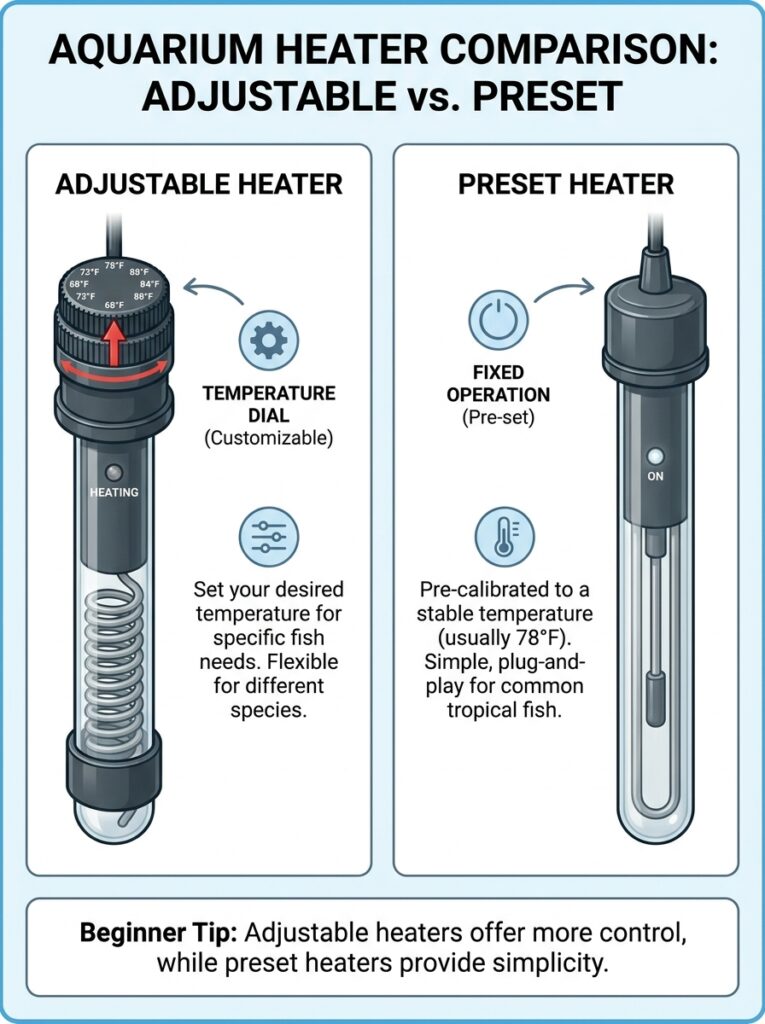
Most small aquarium heaters fall into two categories: adjustable and preset.
1. Adjustable Heaters
Adjustable heaters let you choose the target temperature instead of using a fixed factory setting.
Advantages:
- More control over the target temperature
- Easier to fine-tune as room conditions change
- Useful when different fish or aquarium setups have different temperature requirements
- More flexibility if you change your aquarium setup later
Best for: Fishkeepers who want more control over their aquarium temperature or expect their setup to change over time.
2. Preset Heaters
Preset heaters are designed to maintain a predetermined temperature range, so there is little or nothing to adjust during setup.
Advantages:
- Simple to set up
- Fewer settings to worry about
- Often a convenient choice for straightforward beginner setups
- Can be less expensive than adjustable models
Best for: Beginners who want a simple heater for a small aquarium and whose room conditions are relatively stable.
Which type should you choose?
For most PetYeti readers, I’d lean toward an adjustable heater because it gives you more flexibility and makes it easier to fine-tune the aquarium as conditions change.
A preset heater can still be a perfectly reasonable choice if simplicity and price are your main priorities.
Whichever type you choose, use a separate aquarium thermometer to check the actual water temperature. The heater setting or preset temperature should not replace an independent temperature reading.
⭐ Best Budget: Tetra HT Submersible Preset Heater
If you want a straightforward heater without adjustable temperature controls, the Tetra HT Submersible Heater is a simple option for smaller aquariums.
The 50W HT10 model is rated for 2–10 gallon aquariums and uses a preset thermostat designed to maintain approximately 78°F. It also has red and green indicator lights that show when the heater is heating or on standby.
Why we picked it
- Simple preset operation
- 50W model is designed for 2–10 gallon aquariums
- Red/green indicator lights
- Submersible design
- Automatic shutoff if an electrical short is detected
PetYeti Take
The main appeal here is simplicity. If your aquarium is within the heater’s recommended range and you don’t need to adjust the target temperature, a preset heater can be easier to use than an adjustable model.
The trade-off is flexibility. Because the HT10 is designed around a preset temperature, it doesn’t give you the same level of temperature adjustment as the Hygger adjustable heater above.
As always, use a separate aquarium thermometer to check the actual water temperature.
Who Should Choose It
Choose this heater if you want a simple option for a small aquarium and its preset temperature and recommended tank range suit your setup.
If you want to choose the target temperature yourself, an adjustable heater is the better fit.
⭐ Best for 20-Gallon Tanks: hygger 100W Small Aquarium Heater
If you’re setting up a larger small aquarium, the hygger Small Aquarium Betta Heater 100W with LED Digital Display is an option worth considering.
The Amazon listing for this model gives several tank-size applications, including 16 and 26 gallons, making it a relevant option for a 20-gallon setup.
Why we picked it
- 100W heating capacity
- LED digital display
- Adjustable temperature control
- Designed for small aquarium applications
- Suitable for freshwater and marine setups according to the product listing
PetYeti Take
For a 20-gallon aquarium, a 100W heater can make sense in many setups, but 100W should not be treated as a universal requirement.
The right choice still depends on your room temperature, target aquarium temperature, and the manufacturer’s recommended range. That’s why we recommend choosing the heater based on the complete setup rather than tank volume alone.
The digital display can also make temperature adjustment and checking more convenient, but you should still verify the actual aquarium temperature with a separate thermometer.
Who Should Choose It
This is a good option to consider if you have a 20-gallon aquarium and want an adjustable heater with a digital temperature display.
If your room is particularly warm or your aquarium has different heating requirements, check the manufacturer’s specifications before choosing the 100W model.
Which Aquarium Heater Should You Buy?
If you’re still deciding, use this simple guide:
- Want the most control? Choose the Hygger Adjustable Aquarium Heater. Its adjustable temperature control gives you more flexibility than a preset heater.
- Want the simplest budget option? Consider the Tetra HT Submersible Heater if its preset temperature and recommended tank range suit your aquarium.
- Setting up a 20-gallon aquarium? Consider the hygger 100W Small Aquarium Heater with LED Digital Display, while still checking your room temperature and the manufacturer’s recommended range.
- Have a very small aquarium? Don’t choose a heater simply because the wattage looks right. Check the exact model’s recommended tank size first.
- Live in a cold room? Pay particular attention to the temperature difference between your room and your target aquarium temperature when choosing the heater.
Whatever you choose, use a separate aquarium thermometer to verify the actual water temperature after installation.
The best aquarium heater isn’t necessarily the most powerful or most expensive one. It’s the heater that is appropriately rated for your tank, suits your room conditions, and gives you the level of control you actually need.
How We Chose These Heaters
We don’t rank aquarium heaters based only on price or customer ratings. For a small beginner aquarium, the right heater needs to fit the tank size, offer appropriate temperature control, and be practical to use day to day.
For this guide, we compared heaters based on:
- Recommended aquarium size and wattage range
- Adjustable versus preset temperature control
- Safety features listed by the manufacturer
- Ease of setup for beginners
- Compact size for small aquariums
- Availability and overall value
We also checked manufacturer specifications when comparing heater wattage and recommended tank sizes. Because heater performance can vary with room temperature, water circulation, placement, and individual aquarium conditions, we recommend using a separate thermometer rather than relying only on the heater setting.
Our goal is simple: help you choose a heater that fits your actual aquarium and your setup, rather than simply choosing the product with the longest feature list or the most reviews.
Best Heater Choices for Common Small Aquariums
The best heater depends on more than tank size. Your fish, room temperature, and how much control you want also matter.
Betta Tanks (5–10 Gallons)
For a small betta aquarium, look for a heater that is properly rated for the tank and gives you enough control to maintain a stable temperature.
An adjustable 25–50W heater can be a practical choice for many 5–10 gallon setups, but always check the manufacturer’s recommended tank range and consider how cool the room gets.
If simplicity is your priority, a preset heater can also work well when its recommended range matches your aquarium and room conditions.
Nano Community Tanks
Small community aquariums can be more sensitive to changes in room temperature because they contain relatively little water.
Choose a heater that is appropriately rated for the aquarium rather than simply choosing the highest wattage available. An adjustable model can be useful if you want to fine-tune the temperature as seasonal room conditions change.
Planted Aquariums
A planted aquarium still needs the same basic approach to heating: choose an appropriately sized heater and maintain a stable temperature suited to the fish and other livestock.
If your planted tank contains tropical fish, an adjustable heater can give you more flexibility when setting and monitoring the temperature.
Plants do not mean you need a more powerful heater. The goal is appropriate, stable heating—not maximum heat.
If Your Room Gets Cold
Room temperature can make a significant difference to heater requirements. A tank in a cool room may need more heating capacity than the same-size aquarium in a warm room.
Before buying, think about the lowest temperature your room typically reaches and check the manufacturer’s wattage guidance for the heater you’re considering.
The Simple Buying Rule
If you want to keep the decision simple:
Choose the heater by tank size + room temperature + the manufacturer’s recommended range, then use a separate thermometer to verify the actual water temperature.
That approach is more reliable than choosing a heater based on wattage alone.
How to Set Up an Aquarium Heater Safely
Choosing the right heater is only part of the job. Correct installation and monitoring are just as important.
1. Check the Manufacturer’s Instructions
Before installing the heater, confirm its recommended tank size, installation position, minimum and maximum water levels, and temperature range.
Different heater models can have different requirements, so don’t assume every heater should be installed in exactly the same way.
2. Place the Heater Where Water Can Circulate
Good water circulation helps distribute heated water through the aquarium.
Follow the manufacturer’s placement instructions and avoid positioning the heater where decorations or equipment prevent normal circulation.
3. Use a Separate Thermometer
After installing the heater, check the aquarium water with a separate thermometer.
This lets you confirm that the actual water temperature matches the temperature you want for your fish.
4. Give the Aquarium Time to Stabilize
Don’t keep changing the heater setting every few minutes.
Allow the aquarium time to respond, then check the water temperature again. Small changes in room temperature can also affect the aquarium, particularly in smaller tanks.
5. Never Run a Submersible Heater Dry
If your heater is designed to remain submerged, follow its minimum water-level requirements carefully.
Never operate a submersible heater outside the water unless the manufacturer specifically says that the model is designed for it.
6. Let the Heater Cool Before Removing It
If you need to remove a heater, unplug it and follow the manufacturer’s instructions for allowing it to cool before taking it out of the aquarium.
This is particularly important when cleaning the tank or performing a water change.
7. Check the Temperature Regularly
A quick thermometer check can help you notice problems before they become serious.
Pay particular attention when the seasons change, the room temperature changes significantly, or you adjust or replace the heater.
PetYeti Tip: A properly sized heater plus a separate thermometer is a much better approach than relying on the heater’s display or setting alone.
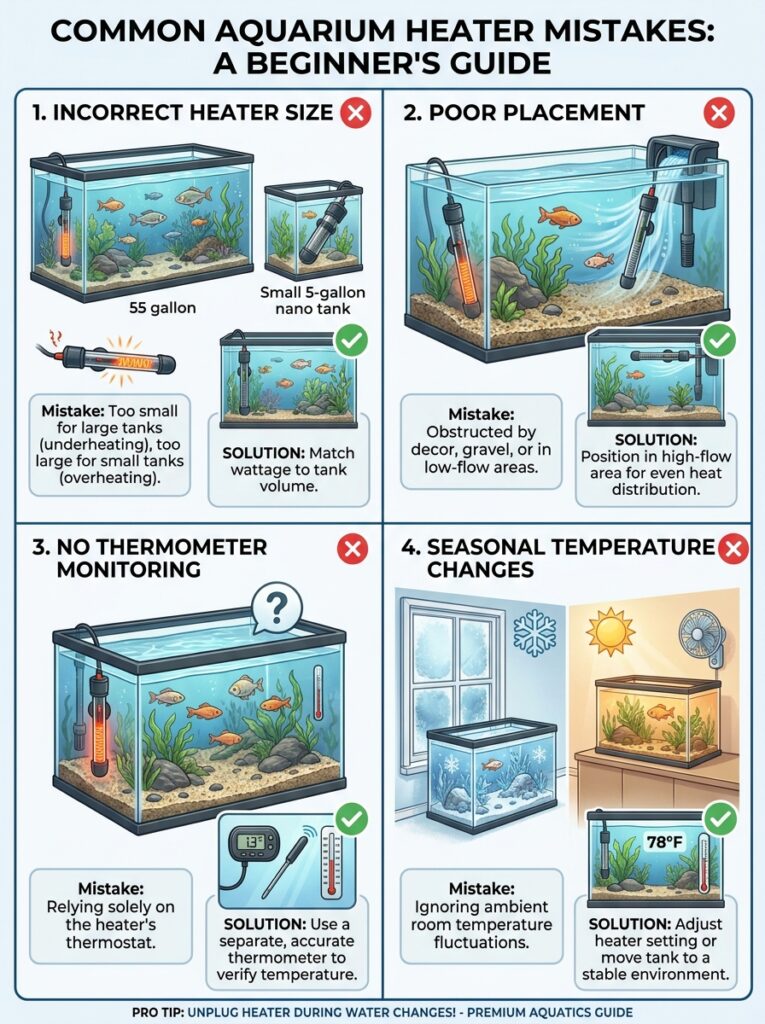
Common Heater Mistakes Beginners Make
Many aquarium heater problems come from choosing the wrong heater or setting it up without checking the actual water temperature.
Choosing by Wattage Alone
A higher wattage is not automatically better. Tank size, room temperature, target water temperature, and the manufacturer’s recommended tank range all matter.
Choose a heater that is appropriately rated for your aquarium rather than simply choosing the largest model that will fit.
Not Using a Separate Thermometer
Even a good aquarium heater should be checked with a separate thermometer.
The heater’s setting tells you what temperature it is designed to maintain; the thermometer tells you what is actually happening in the aquarium.
Placing the Heater Poorly
Heater placement affects how evenly warmth is distributed through the aquarium.
Follow the manufacturer’s installation instructions and place the heater where water circulation can distribute the warmed water through the tank. Avoid positioning it where decorations or equipment prevent normal circulation.
Ignoring Room Temperature
A heater that works well in a warm room may have a harder time maintaining the same water temperature when the room becomes much colder.
Think about the lowest room temperature your aquarium is likely to experience, especially during winter, before choosing the heater.
Removing a Heater While It Is Still Hot
Never remove a heater from the water immediately after it has been running.
Follow the manufacturer’s instructions and allow the heater to cool before taking it out of the aquarium. This helps reduce the risk of thermal shock to the heater itself.
Assuming the Heater Setting Is Always the Actual Water Temperature
The number displayed or selected on a heater is not a substitute for monitoring the aquarium.
Check the water with a separate thermometer after installation and continue checking periodically, especially when room temperatures change or you adjust the heater.
⭐ Helpful Add-On: Digital Aquarium Thermometer
Recommended Option: Digital Aquarium Thermometer
Why We Like It:
✓ Quick temperature checks
✓ Easy-to-read display
✓ Helps verify heater performance
PetYeti Take:
Even reliable heaters benefit from occasional monitoring. A thermometer helps catch temperature swings before fish become stressed.
Who Should Skip It:
Skip this only if you already use a reliable separate thermometer to check the water temperature.
Keep Track of Your Aquarium Care
Once your heater is installed, keeping a simple record of temperature checks and other aquarium care can make it easier to notice changes over time.
CalmTank is a free aquarium-care companion from PetYeti that lets you record water tests, observations, maintenance, tank changes, and reminders in one place.
If you’re building a new aquarium and want an easier way to keep up with the routine,
you can try CalmTank free.
Related PetYeti Guides
A small tank heater works best when you also track temperature, tank size, and betta comfort.
Need to check temperature accurately? Read our beginner aquarium thermometer guide.
Not sure if your heater is working? See why your aquarium heater is not working.
Still choosing the tank size? Read choosing the right aquarium size for beginners.
Setting up a betta tank? See our guide to setting up a beautiful betta fish tank for beginners.
Want fewer betta stress problems? Read how to create a stress-free betta fish tank.
Conclusion
Choosing the best aquarium heater for a small tank is less about finding the most powerful model and more about finding one that matches your aquarium, room temperature, and the manufacturer’s recommended range.
For many beginners, an adjustable heater is a useful choice because it gives you more control over the target temperature. A preset heater can also be a good option when simplicity and price are the main priorities.
Among the options in this guide:
- Hygger Adjustable Aquarium Heater: A flexible choice if you want adjustable temperature control.
- Tetra HT Submersible Preset Heater: A simple option for smaller tanks when its preset temperature and recommended range suit your setup.
- hygger 100W Small Aquarium Heater with LED Digital Display: An option to consider for larger small aquariums, including many 20-gallon setups.
Whichever heater you choose, check the manufacturer’s recommended tank range and use a separate aquarium thermometer to verify the actual water temperature.
The goal isn’t maximum heating power. It’s stable, appropriate temperature control for your particular aquarium.
Best choice for most beginners
If you just want one heater that works well in most 5–20 gallon freshwater tanks, we’d choose the Hygger Adjustable Aquarium Heater. It gives you adjustable temperature control, fits easily in small aquariums, and is the option we’d feel most comfortable recommending to a new fishkeeper.
FAQs
What size heater do I need for a 5-gallon tank?
A 25–50W heater may be suitable for a 5-gallon aquarium, depending on the specific heater, room temperature, and the manufacturer’s recommended tank range. Always check the model’s specifications before buying.
Is a 50W heater enough for a 10-gallon aquarium?
A 50W heater is a common starting point for a 10-gallon aquarium, but the right choice also depends on room temperature and the heater manufacturer’s recommendations.
What size heater should I use for a 20-gallon tank?
A 75–100W heater is a reasonable starting range for many 20-gallon aquariums, but colder rooms may require different heating capacity. Check the manufacturer’s recommended range for the exact heater you are considering.
Are adjustable heaters better than preset heaters?
Not necessarily. Adjustable heaters offer more control and flexibility, while preset heaters can be simpler and less expensive. The better choice depends on how much control you want and whether the heater’s preset temperature suits your aquarium.
Do betta fish need a heater?
Bettas are tropical fish and generally need warm, stable water. A properly sized aquarium heater can help maintain suitable conditions when room temperature alone is not warm or stable enough.
Should I use a thermometer with an aquarium heater?
Yes. A separate aquarium thermometer lets you verify the actual water temperature rather than relying only on the heater’s setting or display.
Can a heater be too powerful for a small aquarium?
Yes. A heater should be appropriately rated for the aquarium. Choosing solely by the highest wattage can be a mistake, particularly in very small tanks. Follow the manufacturer’s recommended tank range and consider your room temperature.
How often should I check my aquarium temperature?
Check the temperature regularly, especially after installing a new heater, changing its setting, replacing equipment, or when room temperatures change significantly. A quick check can help you spot problems early.