
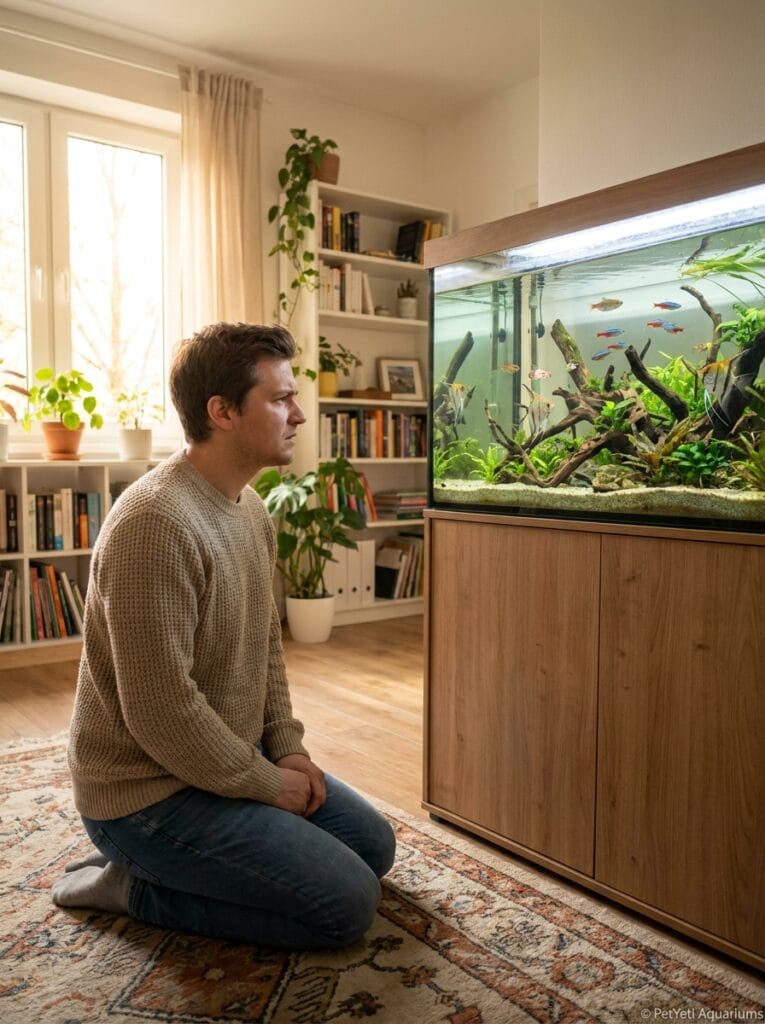
You topped off your aquarium recently, but the water level already looks noticeably lower.
Before assuming your tank is leaking, take a breath. Some water loss is completely normal, especially from evaporation. But if the water is disappearing faster than usual, it is worth figuring out where that water is actually going.
The first thing I would ask is simple:
Is the water evaporating, splashing or wicking out of the tank, or actually leaking?
Those possibilities can look surprisingly similar at first.
In this guide, we’ll go through the most common causes of aquarium water loss, what to check first, how to distinguish evaporation from a leak, and when you should take the situation more seriously.
First, Is Your Aquarium Actually Losing Water?
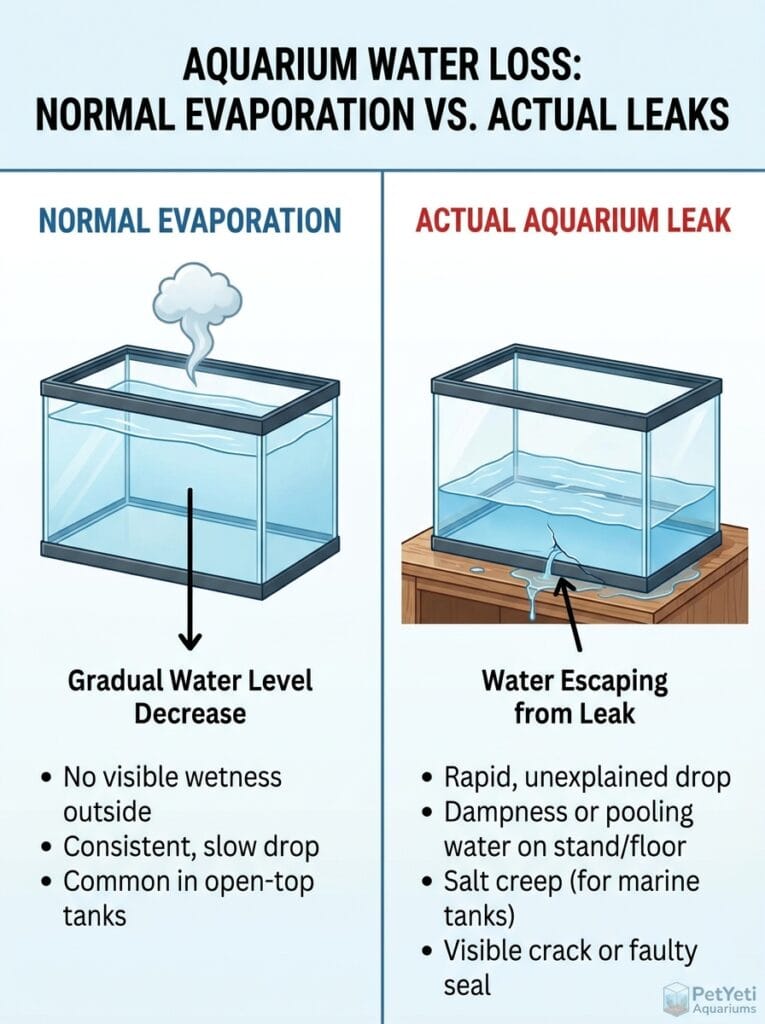
A lower water level does not automatically mean your aquarium has a leak.
Water can leave the tank in several ways:
- Evaporation from the exposed water surface
- Splashing from strong surface movement or equipment
- Wicking when water travels along cords, tubing, plants, or other materials
- Filter or equipment issues that redirect water outside the tank
- Water removed during maintenance
- An actual leak through equipment, seals, seams, or damaged glass
The important distinction is whether the water is simply leaving the aquarium naturally or ending up somewhere it shouldn’t.
A quick reality check
Before changing anything, look around the aquarium.
Check:
- The floor underneath and around the tank
- The cabinet or stand
- The wall behind the aquarium
- Around the filter
- Around heater and air-line equipment
- Along tubing and electrical cords
- Underneath the aquarium if you can safely inspect it
If everything is completely dry and the water level has been dropping gradually, evaporation becomes more likely.
If you repeatedly find unexplained moisture outside the tank, investigate for a leak or equipment problem.
- First, Is Your Aquarium Actually Losing Water?
- The 2-Minute Check: What I Would Look at First
- Why Is My Aquarium Losing Water? 9 Common Causes
- 1. Normal Evaporation
- 2. Strong Surface Movement
- 3. Water Is Splashing Out
- 4. Water Is Being Wicked Away
- 5. A Filter or Other Equipment Is Redirecting Water
- 6. Recent Maintenance Removed More Water Than You Realized
- 7. An Actual Leak
- 8. A Damaged Seam or Structural Problem
- 9. A Change in the Room Environment
- How to Tell Evaporation From a Leak
- How to Check Whether Your Aquarium Is Leaking
- What Should You Do If Your Aquarium Is Just Evaporating?
- How to Reduce Aquarium Water Loss
- Should You Keep Topping Off the Aquarium?
- When Should You Actually Be Worried?
- Common Mistakes to Avoid
- CONCLUSION
- If This Were My Tank…
- The Quick Answer
- FAQs
As an Amazon Associate, PetYeti earns from qualifying purchases. This comes at no additional cost to you and helps support the site. We only recommend products we genuinely believe can help create healthier and more enjoyable aquariums.
The 2-Minute Check: What I Would Look at First
If I noticed my aquarium suddenly losing more water than usual, I wouldn’t start by buying anything.
I’d check these things first.
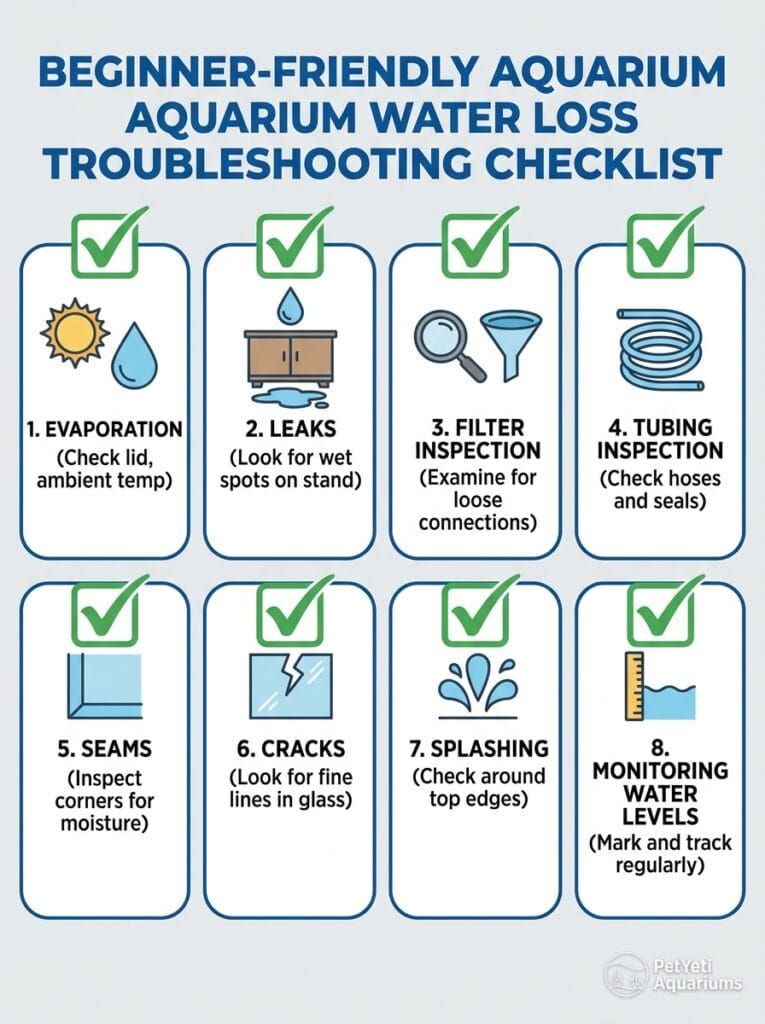
1. Look around the tank
Run your hand around the accessible areas of the stand and cabinet.
Look for:
- Damp spots
- Water marks
- Swelling or discoloration
- Drops collecting underneath equipment
- Moisture on the floor
Even a small leak can leave evidence.
2. Check the filter
Filters are easy to overlook because the water may not be leaking directly from the aquarium.
Look for:
- Water splashing over the rim
- An incorrectly positioned outlet
- Excessive surface agitation
- Water running down the outside of tubing
- Loose connections
- Water escaping around filter components
- A filter chamber or compartment overflowing
A small amount of water moving out of the tank every day can eventually become a noticeable drop in water level.
3. Check your equipment and cords
Water can travel farther than you expect.
A drip may run along tubing or an electrical cord before falling somewhere away from its original source.
A useful detail to check is whether cables or tubing form a path that allows water to run outward rather than back into the aquarium.
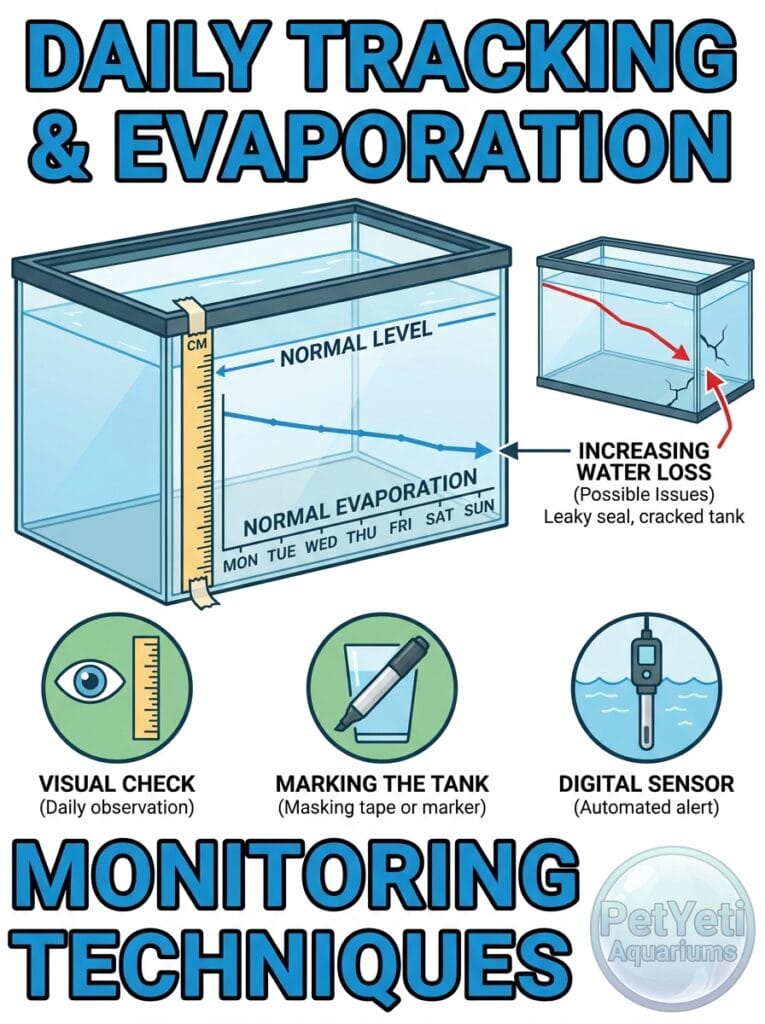
4. Look at the waterline
Compare the current water level with where you normally keep it.
If you regularly top off the tank, marking the waterline with a small piece of removable tape can make changes much easier to notice.
5. Think about what changed
Ask yourself:
What is different from a week ago?
For example:
- Did the room become warmer?
- Did you start using air conditioning?
- Did you remove a lid?
- Did you add a fan?
- Did you change the filter outlet?
- Did you increase surface movement?
- Did you perform maintenance recently?
- Did you move or replace equipment?
Sometimes the cause is simply a recent change that increased water loss.
Why Is My Aquarium Losing Water? 9 Common Causes
1. Normal Evaporation
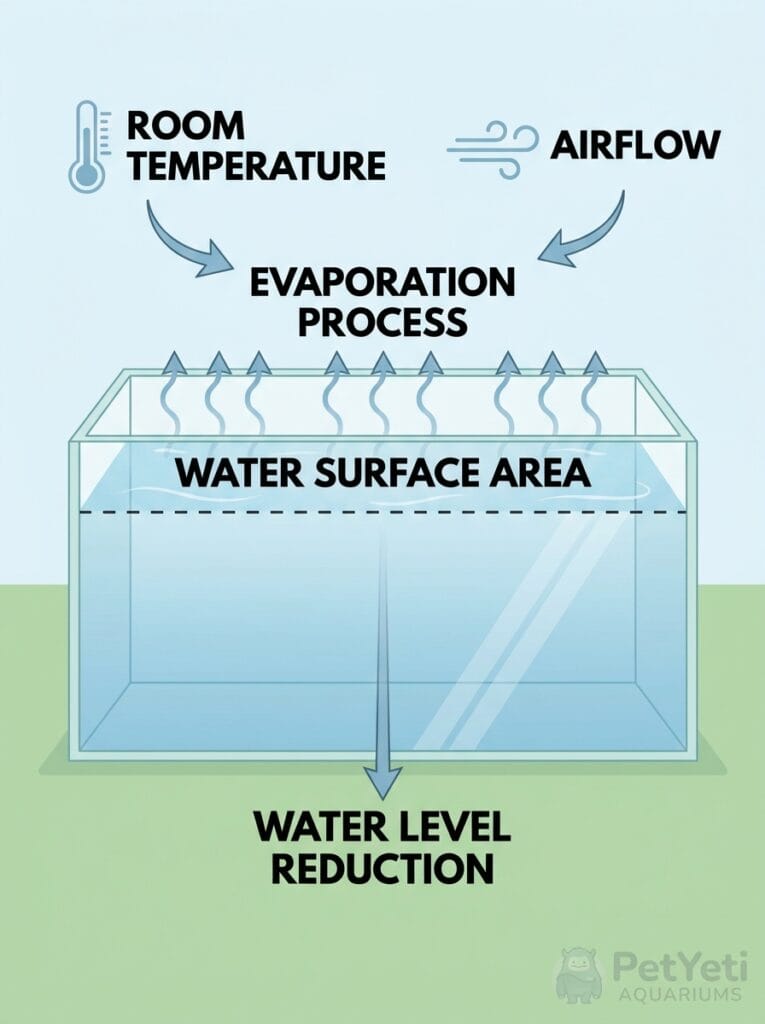
Evaporation is the most obvious explanation for a gradually falling water level.
Water molecules leave the surface of the aquarium and enter the air. The rate can vary considerably depending on the conditions around the tank.
Evaporation tends to increase when you have:
- An open-top aquarium
- A large exposed water surface
- Warm room temperatures
- Strong surface agitation
- Fans blowing across the aquarium
- Dry indoor air
- Heating or air-conditioning changes
This is particularly noticeable with tanks that have a large open surface.
Important: there isn’t one universal amount of evaporation that every aquarium should experience. Tank size, surface area, room conditions, temperature, airflow, and whether the tank has a lid can all make a difference.
If the aquarium stays completely dry around the outside and the water level falls gradually, evaporation may simply be part of your tank’s normal routine.
- PetYeti Pick: Installing a H2Pro Clear Glass Canopy or custom acrylic lid traps rising moisture and cuts aquarium evaporation by up to 85%.
Real-Life Example:
If you run a rimless 10-gallon tank on your desk right under a central air conditioning vent, you might lose half a gallon of water every three days. Simply adding a sleek glass lid eliminates the need to top off the tank every other morning.
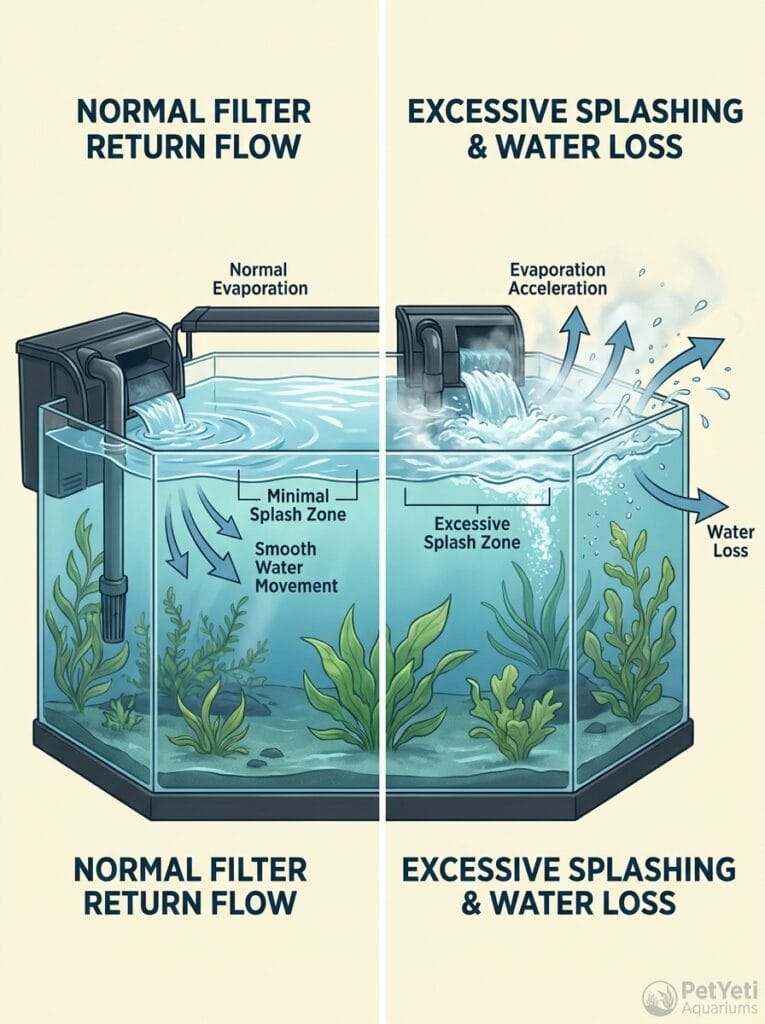
2. Strong Surface Movement
A filter that creates a lot of surface agitation can increase water loss.
Surface movement is useful for gas exchange, but constantly breaking and disturbing the water surface can also increase evaporation.
Look at your filter outlet.
If it is producing a strong stream, waterfall effect, or lots of splashing, some of that water may be leaving the aquarium rather than simply circulating inside it.
You don’t necessarily need to eliminate surface movement. The goal is to make sure it is appropriate for your aquarium rather than unnecessarily aggressive.
PetYeti Pick: Place high-clarity rimless tanks on a high-density Aquarium Self-Leveling Foam Mat to absorb structural vibrations and uneven desk surfaces.
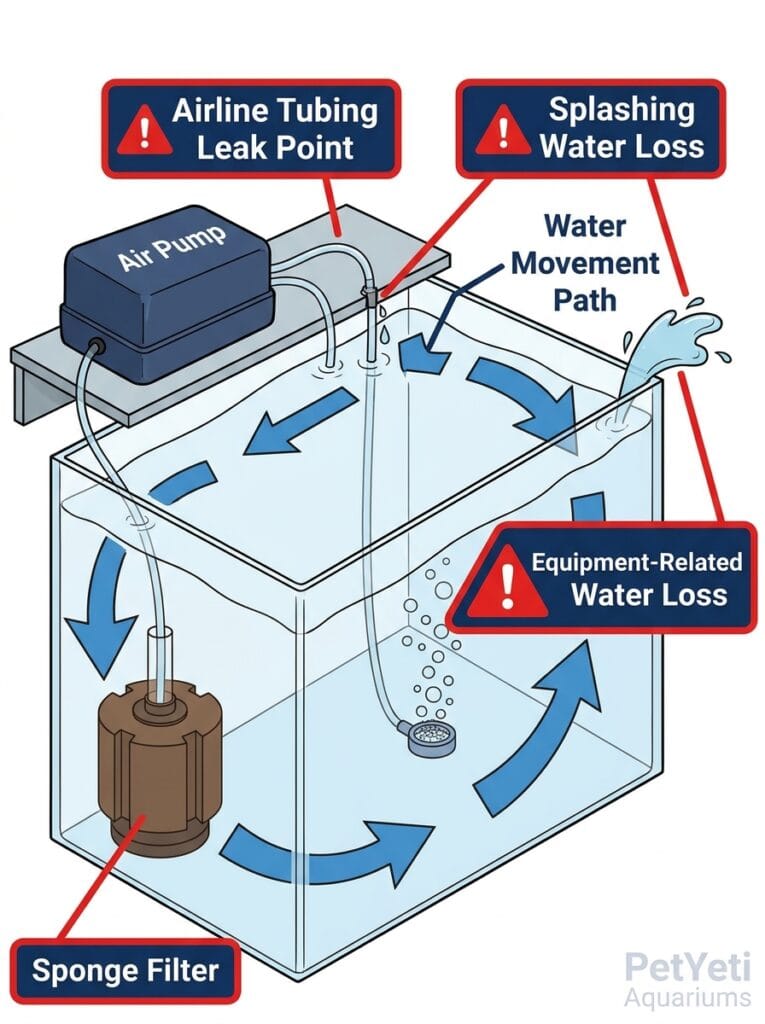
3. Water Is Splashing Out
Sometimes water isn’t evaporating at all.
It is simply leaving the tank.
This can happen with:
- Strong filter outlets
- Air stones
- Bubbling equipment
- Water returning from a canister filter
- Fish that repeatedly splash near the surface
- Equipment positioned too close to the rim
Check the area immediately around the aquarium.
A small amount of splashing may be difficult to notice until you see water marks, salt or mineral deposits, or dampness around the tank.
4. Water Is Being Wicked Away
Wicking is one of those small things that is surprisingly easy to miss.
Water can travel along a material that is touching or very close to the aquarium water.
For example, moisture can sometimes travel along:
- Filter tubing
- Airline tubing
- Plant leaves or stems
- Cords
- Cloth or other absorbent material
The water may then drip somewhere outside the aquarium.
If you’re finding a damp area but can’t immediately see where it came from, follow the path of anything that touches the water or sits close to the rim.
This is one of the first things I’d check if the tank appears to be losing water but you cannot find an obvious leak.
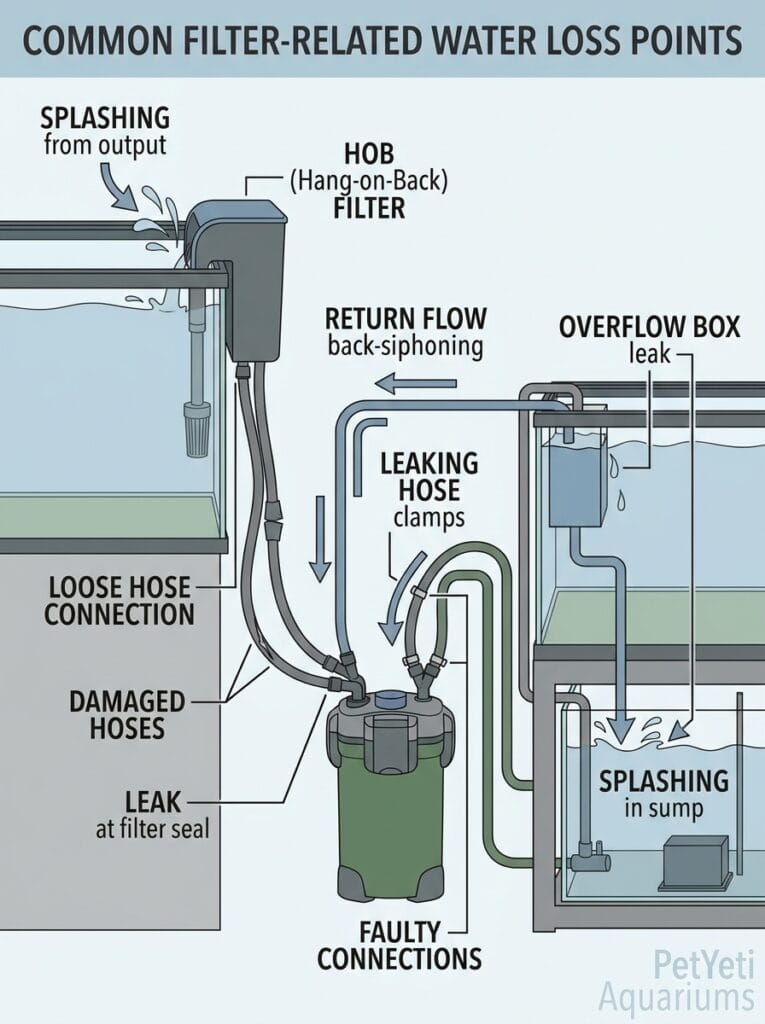
5. A Filter or Other Equipment Is Redirecting Water
Equipment problems can make water disappear surprisingly quickly.
Check for:
- Loose filter connections
- Cracked tubing
- Incorrectly positioned return outlets
- Blockages causing unusual flow
- Water escaping around filter components
- Overflowing filter compartments
- Air-line or bubbling equipment splashing water outside the tank
Don’t assume the glass aquarium itself is the problem.
Sometimes the tank is perfectly intact and the water is escaping through something attached to it.
6. Recent Maintenance Removed More Water Than You Realized
This sounds obvious, but it’s easy to forget.
If you’ve recently:
- Performed a water change
- Cleaned the substrate
- Cleaned the filter
- Removed plants
- Repositioned decorations
- Vacuumed the aquarium
you may have removed more water than expected.
This isn’t a leak, but it can make a normal water level change look mysterious if you don’t remember exactly how much water was removed.
7. An Actual Leak
A real leak is more concerning because water is leaving the aquarium through a path it shouldn’t.
Possible signs include:
- Persistent moisture around the aquarium
- Water appearing underneath the tank
- A wet cabinet or stand
- Water collecting in one particular area
- A water level that continues dropping unusually quickly
- Moisture that returns after the area has been dried
If you repeatedly find water outside the aquarium, don’t keep assuming it is evaporation.
Investigate the source.
💡 Important Tip: How to Top Off Evaporated Water Correctly
When water evaporates from your tank, only pure H2O leaves—minerals, salts, and dissolved solids stay behind in the aquarium.
If you continuously top off evaporated water using hard tap water, mineral concentrations (Total Dissolved Solids / TDS) will steadily rise, stressing delicate fish and shrimp. For daily top-offs, always use distilled water or RO (Reverse Osmosis) water. Reserve your regular treated tap water for weekly water changes where old minerals are removed first.
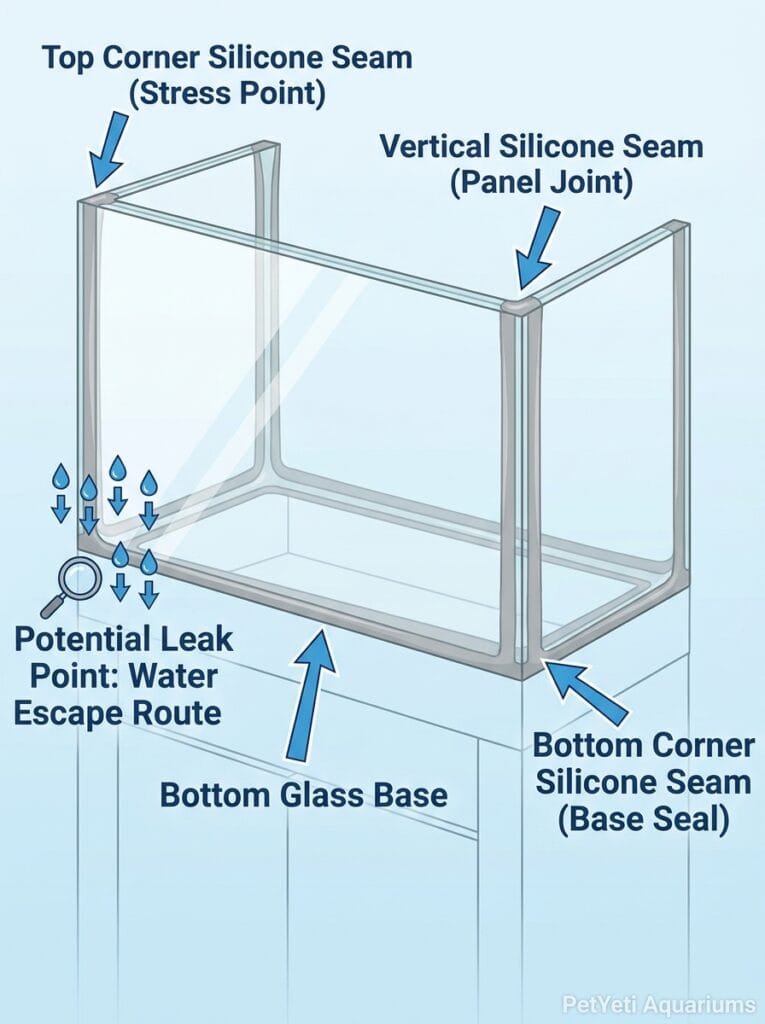
8. A Damaged Seam or Structural Problem
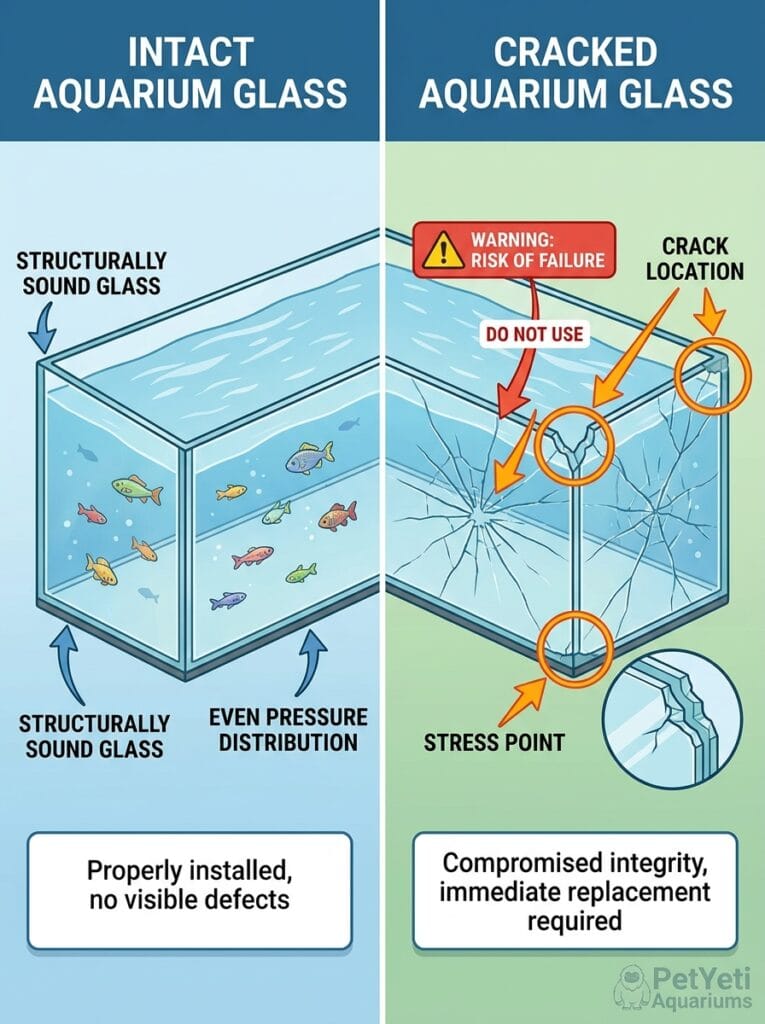
Aquariums are held together by their construction and sealed joints. Damage to a seam or the aquarium itself can allow water to escape.
Pay particular attention to:
- Silicone seams
- Corners
- Areas with visible damage
- Cracks or chips in the glass
- Unusual bulging or structural changes
If you can clearly see structural damage or a significant leak, treat it as a safety issue rather than something to experiment with.
Protect the surrounding furniture, floor, electrical equipment, and—most importantly—the fish.
9. A Change in the Room Environment
Sometimes the aquarium hasn’t changed much, but the environment around it has.
Water loss can increase when conditions change, such as:
- The room becomes warmer
- Indoor air becomes drier
- Air conditioning starts running more often
- A fan begins blowing across the aquarium
- Seasonal conditions change
- A previously covered tank becomes more open
If the aquarium was stable for months and suddenly begins losing water faster, think about what changed around it.
How to Tell Evaporation From a Leak
There isn’t always a single clue that proves what is happening.
Instead, look at the pattern.
| What you notice | More consistent with evaporation | More concerning for a leak |
|---|---|---|
| Water level falls gradually | ✓ | Possible |
| Aquarium area stays completely dry | ✓ | Less likely |
| Water appears on cabinet or floor | Less likely | ✓ |
| Water loss changes with room temperature | ✓ | Less likely |
| Open-top aquarium | ✓ | — |
| Strong surface agitation | ✓ | — |
| Persistent unexplained moisture | — | ✓ |
| Water appears underneath the tank | — | ✓ |
| Damaged seam or glass | — | ✓ |
| Water loss suddenly becomes much faster | Possible | Possible |
These clues are not absolute proof.
For example, evaporation can increase suddenly after a change in room conditions, while a small equipment leak may leave very little visible water.
That’s why a simple monitoring test can be useful.
Real-Life Example
A new aquarium owner became convinced their tank was leaking because the water level dropped nearly an inch in a week. After a careful inspection, no moisture was found around the aquarium. The water loss turned out to be normal evaporation caused by an uncovered tank.
How to Check Whether Your Aquarium Is Leaking
If you aren’t sure what’s happening, start by drying any visible moisture around the aquarium.
Then:
- Make sure the filter and equipment are positioned normally.
- Check tubing, outlets, and connections.
- Mark the current waterline.
- Keep an eye on the area around the aquarium.
- Check the water level again later.
- Look for where moisture appears first if water returns.
Don’t immediately change several things at once.
If you move the filter, change the water level, remove the lid, change the room temperature, and alter the equipment simultaneously, it becomes much harder to understand what caused the change.
If you find a clear structural leak
That’s different.
If water is escaping from the aquarium itself or you see damage to a seam or the glass, prioritize safety rather than trying to prove exactly how much water is being lost.
Keep water away from electrical equipment and protect the surrounding furniture and floor.
If the structural condition appears unsafe, seek appropriate aquarium repair or replacement advice rather than continuing to operate the tank as normal.
What Should You Do If Your Aquarium Is Just Evaporating?
If you’ve checked the aquarium and equipment and everything is dry, gradual water loss may simply be evaporation.
In that case, the solution usually isn’t to eliminate evaporation completely.
Instead, make it manageable.
Things that can reduce evaporation include:
- Using an appropriate aquarium lid or cover
- Reducing unnecessary splashing
- Avoiding excessive surface agitation
- Keeping fans from blowing directly across the water
- Keeping the aquarium away from unusually warm or drafty locations
For a deeper explanation of why aquarium water evaporates quickly and how room conditions affect it, see our dedicated guide:
Why Is My Aquarium Water Evaporating Quickly?
That article is specifically about evaporation. This guide is the broader troubleshooting guide for figuring out where your missing water is going.
How to Reduce Aquarium Water Loss
Once you’ve identified the cause, the fix is usually straightforward.
If evaporation is the cause
Consider:
- A suitable lid or cover
- Less unnecessary surface agitation
- Reducing direct airflow across the tank
- Keeping room conditions reasonably stable
If splashing is the cause
Check the position and strength of:
- Filter outlets
- Air stones
- Return lines
- Bubblers
You want useful water movement without constantly throwing water outside the aquarium.
If wicking is the cause
Look for the path the water is following.
Reposition tubing, cords, or other materials so water cannot travel outward and drip away from the tank.
If equipment is the cause
Inspect the equipment carefully and correct the source of the escape rather than simply replacing evaporated water.
If a leak is the cause
Treat the underlying leak as the problem.
Repeatedly topping off the aquarium doesn’t solve a structural leak.
Should You Keep Topping Off the Aquarium?
If the missing water is genuinely evaporated water, topping off can be part of normal aquarium maintenance.
But don’t use topping off as a substitute for finding the cause of unexplained water loss.
If water is leaving because of a leak or equipment problem, continually adding more water only hides the symptom.
A good rule is:
If you don’t know where the water is going, investigate before turning topping off into the routine.
Also remember that evaporation removes water while leaving dissolved substances behind. Regular aquarium maintenance and water changes still matter even when you’re topping off evaporated water.
When Should You Actually Be Worried?
Think about the situation in three broad levels.
Gradual and explainable
The water level drops slowly, the area around the aquarium stays dry, and you have obvious evaporation conditions.
That’s generally much less concerning.
Faster than usual
The aquarium is losing noticeably more water than it normally does, but you haven’t found a clear source.
That’s when I’d investigate the filter, tubing, surface movement, room conditions, and possible wicking.
Visible or persistent water outside the aquarium
This deserves more attention.
If you repeatedly find water around the tank, underneath it, or near the equipment, don’t simply assume it is evaporation.
Find the source.
And if you see a damaged seam, cracked glass, or another obvious structural problem, prioritize the safety of the aquarium and everything around it.
Common Mistakes to Avoid
Assuming every drop is a leak
Evaporation is normal in many aquariums.
Assuming every drop is evaporation
If water is appearing outside the tank, investigate.
Repeatedly topping off without investigating
Replacing the missing water doesn’t tell you why it disappeared.
Changing several things at once
Make one change at a time when troubleshooting.
Ignoring filter splash
A filter can move water outside the aquarium without the glass itself leaking.
Forgetting about wicking
A small amount of water can travel surprisingly far along tubing, cords, plants, or other materials.
Looking for a universal evaporation rate
There isn’t one number that applies equally to every aquarium.
Related PetYeti Aquarium Maintenance Guides
- Setting up quiet, reliable filtration? Browse our top quiet aquarium filters for bedrooms and living rooms.
- Planning a clean, modern setup? Check out our guide on minimalist aquascaping ideas.
- Fish acting strange after water level changes? Read our troubleshooting guide on why do my fish stay at the surface.
CONCLUSION
Noticing your aquarium water drop quickly can give you a momentary scare, but in the overwhelming majority of homes, the culprit is simple physics—natural evaporation accelerated by dry air or open-top glass.
By running a quick paper-towel check along your bottom seams, inspecting filter leveling, and placing a clear glass lid over the top, you can stop rapid water loss in its tracks. You’ll keep your water parameters stable, protect your heaters and filters, and spend less time topping off tanks and more time enjoying your peaceful underwater view.
PetYeti Quick Recap: Best Fixes for Rapid Water Loss
To cut daily evaporation down to almost zero, install an H2Pro Clear Glass Canopy tailored to your tank dimensions. For open-top rimless purists, an automated Smart ATO (Auto Top-Off) Unit keeps your waterline rock-solid automatically using pure top-off water.
If This Were My Tank…
I wouldn’t start by buying anything.
I’d first check the floor, cabinet, filter, tubing, equipment, and areas around the aquarium for moisture.
Then I’d look for splashing or wicking and mark the waterline so I could see how quickly the level was actually changing.
If everything stayed dry and the water loss was gradual, I’d look at evaporation and recent changes in the room.
The important thing is to eliminate the simple possibilities one at a time.
A lower water level doesn’t automatically mean you have a leaking aquarium. But unexplained water loss is worth investigating rather than simply topping off and forgetting about it.
The Quick Answer
If your aquarium is losing water faster than usual, first determine whether the water is:
evaporating → splashing/wicking away → escaping through equipment → or leaking from the aquarium itself.
Start with the simple checks.
Look around the tank. Check the filter. Follow tubing and cords. Look for splashing. Mark the waterline. Think about recent changes in the room.
If the tank stays dry and the water loss is gradual, evaporation may be the explanation.
If water keeps appearing outside the aquarium, investigate further rather than assuming it is normal evaporation.
FAQs
Why is my fish tank losing water but I can’t find a leak?
Evaporation is one possibility, especially if the tank is open and the surrounding area stays completely dry.
Also check for splashing, wicking, filter problems, and water escaping along tubing or cords.
How fast should aquarium water evaporate?
There is no universal rate.
Evaporation depends on factors such as tank surface area, temperature, airflow, humidity, surface movement, and whether the aquarium has a lid.
What’s more useful is knowing what is normal for your own aquarium and noticing when that pattern changes.
Can a fish tank lose water overnight?
Yes.
An aquarium can lose noticeable water overnight through evaporation, splashing, or an equipment problem.
If the change is much greater than usual, check the aquarium and surrounding area rather than assuming it is normal.
Does a heater make aquarium water evaporate faster?
The overall temperature of the aquarium and the surrounding environment can affect evaporation.
However, don’t assume that the heater itself is necessarily the cause. Look at the whole set of conditions around the aquarium.
Can a filter cause aquarium water to disappear?
Yes.
A filter can cause water loss through splashing, an incorrectly positioned outlet, tubing problems, overflow, or water escaping around equipment.
Should I top off evaporated water?
If you’ve confirmed that the water loss is evaporation, topping off can be part of normal maintenance.
If you don’t know why the water is disappearing, investigate first.
How do I know if my aquarium has a leak?
Look for persistent moisture around the aquarium, water underneath the tank, wet equipment or tubing, returning dampness after drying the area, or visible damage to seams or glass.
Why is my aquarium suddenly losing more water?
Think about what recently changed.
Room temperature, airflow, humidity, filter positioning, surface agitation, removing a lid, equipment changes, or a new source of splashing can all change water loss.
Does a lid reduce aquarium evaporation?
A suitable lid can reduce the amount of water that escapes from the exposed surface, although the effect depends on how much of the aquarium is covered and the conditions around it.