
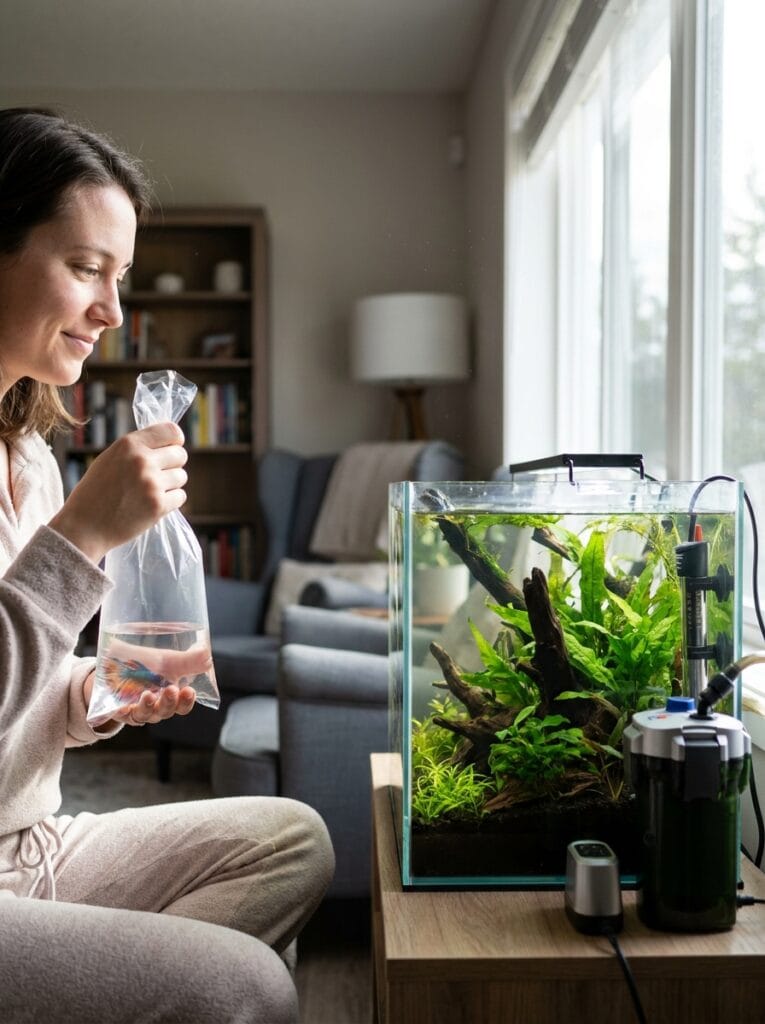
If you’re asking yourself can you add fish immediately after setting up a tank—perhaps you just filled a brand-new aquarium with tap water, turned on the filter, and are eager to bring home your first fish—the short answer is no, you shouldn’t.
While it’s tempting to add fish on day one, raw tap water lacks the beneficial bacteria needed to break down toxic fish waste. Dropping fish into an uncycled aquarium right away leads to unseen ammonia spikes, heavy gill stress, and fast fish loss within a few days.
However, if you’ve already bought fish today, don’t panic! You can safely manage an uncycled tank if you follow a specific rescue routine.
PetYeti 10-Second Quick Answer
- The Golden Rule: Ideally, wait 2 to 4 weeks to cycle your aquarium before adding fish so beneficial bacteria can build up.
- Already Have Fish in the Tank? Use bottled nitrifying bacteria (like Seachem Stability or API Quick Start), perform daily 20% water changes, and detoxify waste with Seachem Prime to keep your fish safe during an emergency “fish-in cycle.”
- Adding Fish Immediately vs. Waiting: What Really Happens
- The Nitrogen Cycle Made Simple (In 3 Steps)
- How to Cycle Your Tank Faster (3 Beginner-Friendly Hacks)
- Emergency Guide: What to Do If You Already Added Fish Today
- Why A New Aquarium Can Look Ready Before It Actually Is
- What Happens If Fish Are Added Too Early?
- But What If I Already Added Fish?
- Beginner Rules Before Adding Fish
- Helpful Next Reads
- CONCLUSION
- FAQs
As an Amazon Associate, PetYeti earns from qualifying purchases. This comes at no additional cost to you and helps support the site. We only recommend products we genuinely believe can help create healthier and more enjoyable aquariums.
Adding Fish Immediately vs. Waiting: What Really Happens
When you pour tap water into a new tank, it looks sparkling clean, but chemically it is completely “sterile.” Fish constantly produce waste (ammonia) through their gills and droppings. Without established beneficial bacteria to consume that ammonia, it builds up rapidly to deadly levels.
Here is what happens inside your tank depending on the path you choose:
| Feature / Outcome | Adding Fish on Day 1 (Uncycled) | Waiting 2–4 Weeks (Fishless Cycle) |
| Ammonia Spike Risk | Extremely High (Spikes within 48–72 hours) | Zero (Bacteria consume ammonia instantly) |
| Fish Stress & Disease | High risk of gill burns, fin rot, and lethargy | Minimal stress; fish adapt smoothly |
| Maintenance Needed | Daily 20% water changes & testing required | Simple testing once or twice a week |
| Beginner Confidence | High anxiety and panic over sick fish | Calm, peaceful, and predictable experience |
| Overall Success Rate | Low (frequent early losses) | 95%+ Long-term success |
The Nitrogen Cycle Made Simple (In 3 Steps)
You don’t need a chemistry degree to keep an aquarium, but understanding the Nitrogen Cycle is the single most important secret to keeping fish alive long-term:
- Step 1: Waste Creates Ammonia (NH3) — Fish waste, uneaten food, and decaying plant leaves break down into ammonia. Ammonia is highly toxic to fish even in tiny amounts.
- Step 2: Nitrosomonas Bacteria Create Nitrite (NO2-) — Beneficial nitrifying bacteria colonize your filter media and substrate, eating ammonia and converting it into Nitrite. Nitrite is also dangerous and prevents fish blood from carrying oxygen.
- Step 3: Nitrobacter Bacteria Create Nitrate (NO3-) — A second type of beneficial bacteria converts Nitrite into Nitrate. Nitrate is far less toxic and is easily controlled through routine 20% partial water changes every week or two.
How to Cycle Your Tank Faster (3 Beginner-Friendly Hacks)
If waiting a full month sounds too long, you can safely speed up the cycling process using these tested hobbyist techniques:
- Use Bottled Nitrifying Bacteria: Adding a live bacterial starter introduces millions of beneficial microbes directly to your filter media on day one.
- PetYeti Pick: Seachem Stability or API Quick Start speeds up filter colonization safely and reliably.
- Borrow Used Filter Media: If you or a friend have an established, healthy aquarium, ask for a piece of used filter sponge or a handful of gravel. It contains active bacteria colonies that can cycle a small tank in as little as 7–10 days!
- Keep Water Warm (78°F–80°F): Beneficial bacteria reproduce much faster in warm, well-oxygenated water. Make sure your aquarium heater is running during the cycle.
- PetYeti Pick: Use an hygger Small Aquarium Heater or Orlushy Submersible Aquarium Heater to maintain a steady 78°F to foster fast bacterial growth.
Emergency Guide: What to Do If You Already Added Fish Today
If you placed fish into your new aquarium before reading this guide, don’t feel bad—almost every aquarium hobbyist has made this exact mistake starting out! You can still save your fish by performing an Emergency Fish-In Cycle:
- Test Water Daily: Use a liquid test kit to monitor Ammonia (NH3) and Nitrite (NO2-) levels every 24 hours.
- Perform 20–30% Daily Water Changes: If Ammonia or Nitrite reads above 0.25 ppm, perform a partial water change immediately with temperature-matched water.
- Double-Dose Seachem Prime: Use Seachem Prime as your water conditioner—it not only removes chlorine but also temporarily detoxifies ammonia and nitrite for 24–48 hours without killing beneficial bacteria.
- Dose Bottled Bacteria Daily: Add a daily dose of Seachem Stability directly into your filter chamber for 7 consecutive days.
- Feed Lightly: Feed your fish sparingly once every two days. Unconsumed food is the #1 cause of fatal ammonia spikes in new tanks.
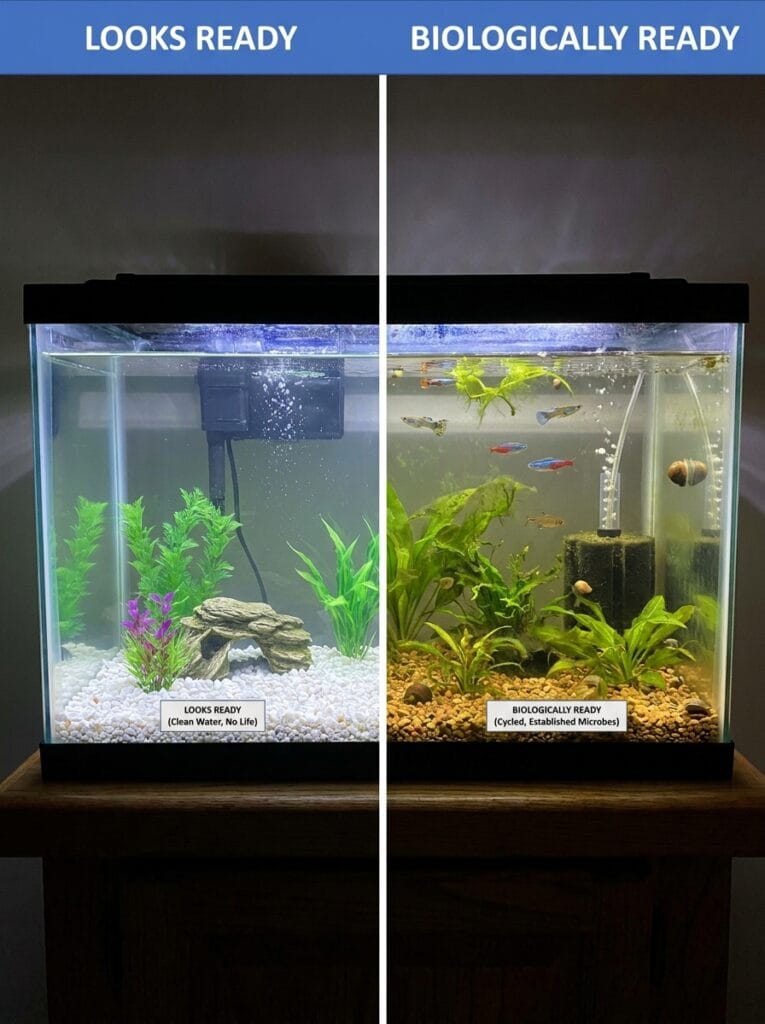
Why A New Aquarium Can Look Ready Before It Actually Is
This part surprises a lot of beginners.
A brand-new aquarium can look beautiful within a few hours. Clear water often creates the feeling that everything is finished. But beneath the surface, important biological changes are still happening.
Beneficial bacteria are gradually developing on:
- Filter media
- Gravel or substrate
- Decorations
- Plants
- Tank surfaces
Real-Life Example
A beginner sets up a new aquarium on Saturday afternoon. By Sunday morning the water looks crystal clear. The tank looks complete. Fish are added later that day. Everything seems fine initially, but several days later the fish begin acting stressed. The problem wasn’t necessarily the fish. The tank simply wasn’t biologically ready yet.
What To Expect
New aquariums often need time even when they already look finished.
What Happens If Fish Are Added Too Early?
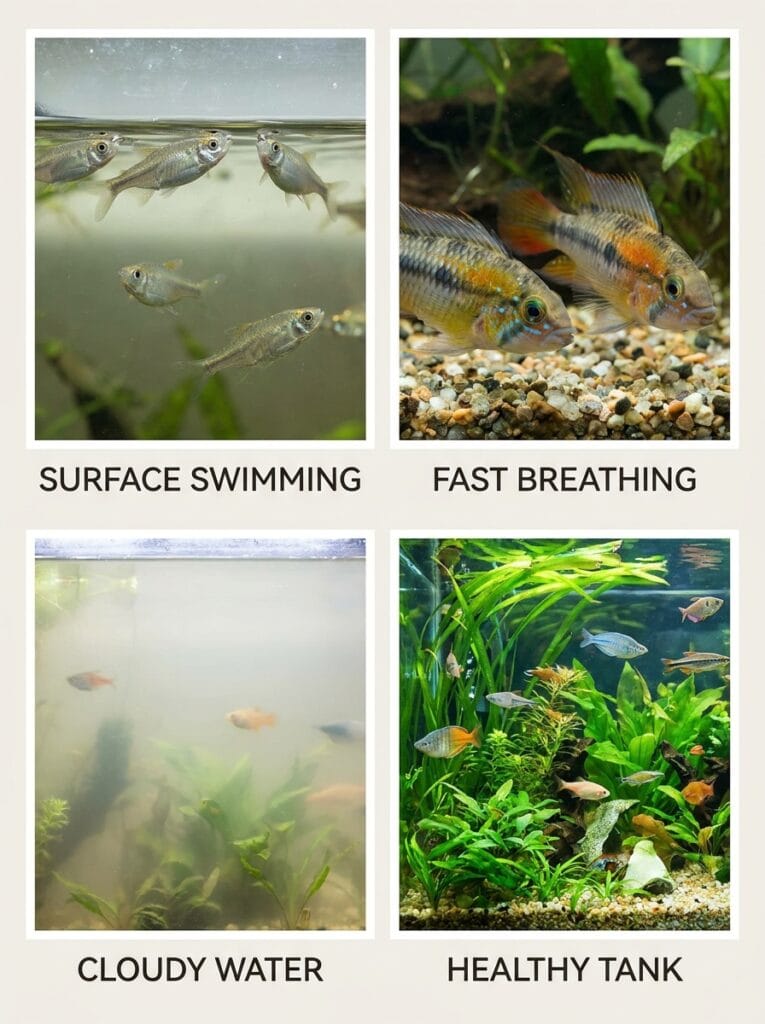
Sometimes nothing obvious happens immediately. That’s why this mistake catches beginners so often. Problems may appear slowly.
Possible signs include:
| Possible Sign | What You May Notice |
| Fish staying near surface | Fish seeking oxygen |
| Faster breathing | Stress or water quality changes |
| Cloudy water | Biological imbalance |
| Reduced activity | Fish becoming stressed |
| Extra maintenance | Water quality becoming unstable |
If fish start breathing unusually fast or spending time near the surface, those can sometimes be early warning signs.
But What If I Already Added Fish?
Take a deep breath.
A lot of beginners end up here. In fact, many people add fish immediately because a store employee told them it would be okay. The goal now isn’t panic.
The goal is stability.
What To Do
- Avoid adding additional fish
- Monitor fish behavior
- Test water regularly
- Feed lightly
- Watch for sudden changes
Real-Life Hobby Moment
Many aquarium owners have had a moment where they look at their tank and think:
“Wait…was I supposed to wait first?”
You’re definitely not the first person to ask that question.
Beginner Rules Before Adding Fish
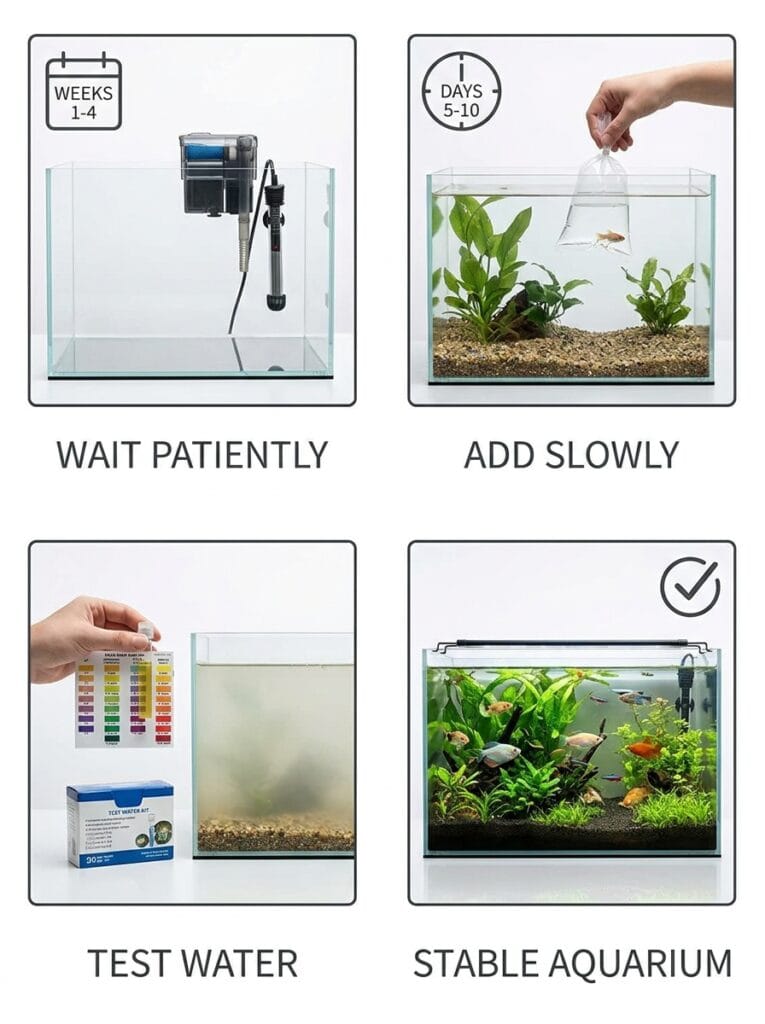
Rule 1: Give the aquarium time
Patience early often creates fewer problems later.
Rule 2: Add fish slowly
Avoid introducing large groups immediately.
Rule 3: Think long-term
A healthy aquarium is being built for the next several years, not just the next few days.
Helpful Next Reads
Adding fish too soon is one of the easiest beginner mistakes to make. These guides can help you check whether the tank is actually ready.
Still learning why new tanks need time? Read Aquarium Cycling Explained for Beginners.
Wondering how long to wait? See our guide on how long it takes for an aquarium to cycle.
Need to check the water first? Use our guide on how to test aquarium water correctly.
Want a simple testing option? See our beginner aquarium test kit guide.
Planning your first fish list? Our guide to how many fish you can put in an aquarium can help you avoid overcrowding.
Setting up a peaceful home for your fish? Read our complete blueprint for a stress-free betta fish tank.
CONCLUSION
While you shouldn’t add fish immediately after filling a brand-new aquarium, waiting 2 to 4 weeks for the nitrogen cycle to complete is the single best investment you can make for a peaceful, stress-free aquarium home.
If you already have fish in the tank, stay calm! By dosing bottled nitrifying bacteria daily, monitoring parameters, and performing gentle 20% water changes, you can safely guide your aquarium through the cycle and enjoy a vibrant, healthy underwater ecosystem for years to come.
PetYeti Quick Recap: Best Immediate Steps for New Tanks
To cycle your tank safely or protect fish in an uncycled aquarium, pair Seachem Prime (to detoxify ammonia and heavy metals) with Seachem Stability (to seed beneficial bacteria instantly). Monitor your parameters with an AAwipes 8-in-1 Aquarium Test Kit to keep your water crystal clear and toxin-free.
FAQs
Can I put fish in a new tank after 24 hours?
Running a filter for 24 hours removes chlorine (if conditioned) and stabilizes water temperature, but it does not cycle the tank. Without adding a bacterial starter or seed media, 24 hours is not enough time to build up the beneficial bacteria required to safely process fish waste.
How do I know when my new aquarium is fully cycled?
Your tank is fully cycled when you can add an ammonia source (or feed the tank) and your liquid test kit reads 0 ppm Ammonia, 0 ppm Nitrite, and a small reading of Nitrate (5–20 ppm) 24 hours later.
What if I already added fish?
Avoid panic. Focus on monitoring fish behavior and maintaining stable conditions.
Will live plants speed up the cycling process?
Yes! Live aquarium plants like Java Fern, Anubias, and Amazon Swords naturally absorb ammonia and nitrates directly from the water, making the cycling period smoother and safer for fish.