
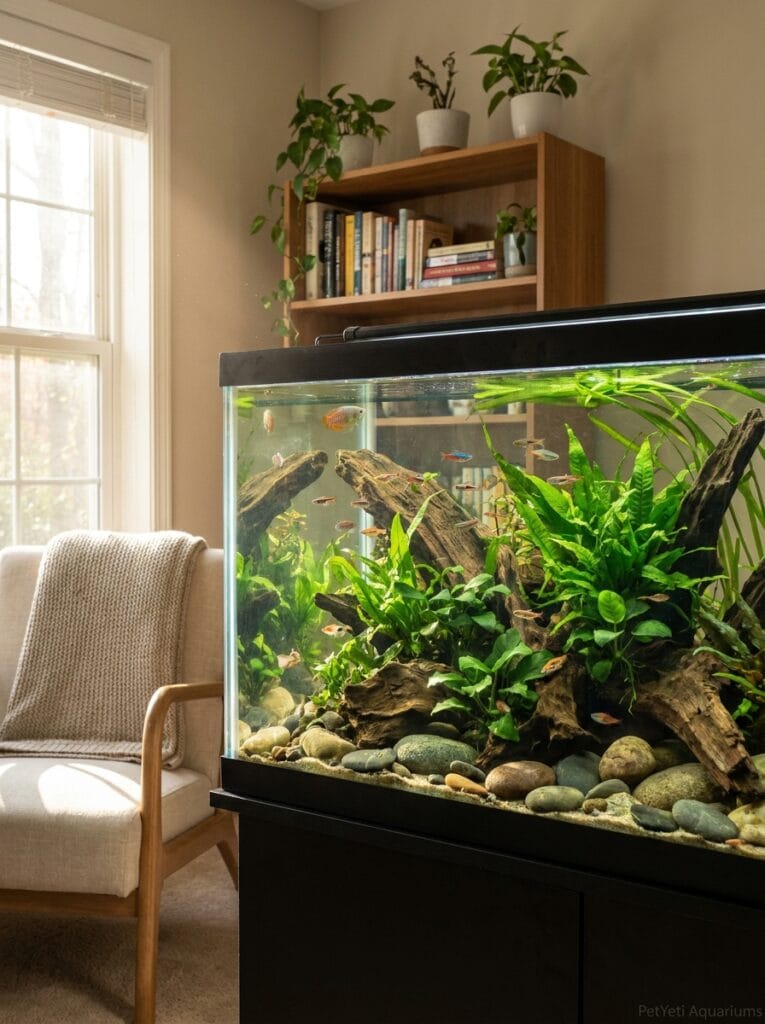
Aquarium plants without CO2 can still grow well when you choose hardy plants, use moderate lighting, keep water stable, and avoid making the tank too complicated.
Then you notice something else.
CO₂ systems.
Pressurized cylinders.
Regulators.
Diffusers.
Bubble counters.
And suddenly what looked like a simple planted aquarium starts feeling expensive and complicated.
The good news?
Many aquarium plants grow perfectly well without CO₂.
In fact, countless hobbyists maintain beautiful planted aquariums for years using nothing more than proper lighting, healthy fish, and a little patience.
If your goal is to create a peaceful, natural aquarium for your home—not a competition aquascape—you may not need CO₂ at all.
In this guide, we’ll explain how aquarium plants grow without CO₂, which plants perform best, and how beginners can build a successful low-tech planted aquarium.
- What Does CO2 Actually Do for Aquarium Plants?
- Can Aquarium Plants Really Grow Without CO₂?
- The Best Aquarium Plants for Tanks Without CO₂
- Why Too Much Light Can Cause Problems
- How Fish Help Aquarium Plants Grow
- Do Low-Tech Aquariums Need Fertilizer?
- Common Mistakes When Growing Aquarium Plants Without CO₂
- A Simple Formula for Success Without CO₂
- CONCLUSION
- FAQs
What Does CO2 Actually Do for Aquarium Plants?
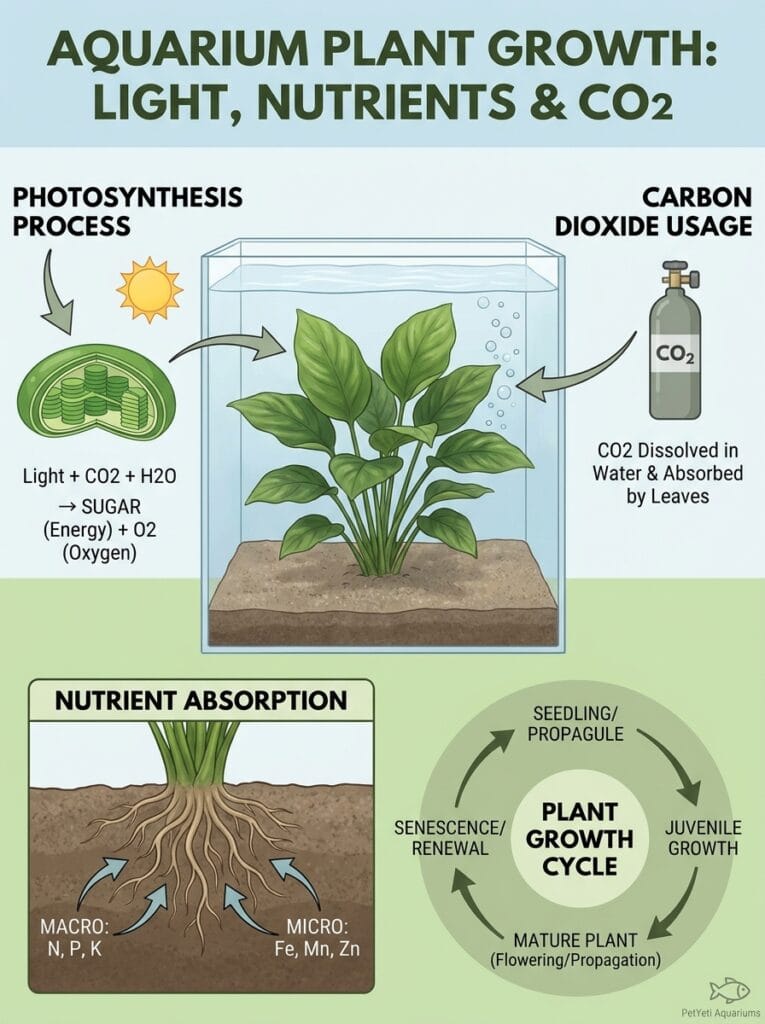
Carbon dioxide is one of the ingredients plants use during photosynthesis.
To grow, aquarium plants generally need:
CO₂ systems provide additional carbon dioxide, allowing plants to grow faster and often more densely.
However, faster growth isn’t always necessary.
Many beginner-friendly plants are adapted to lower-carbon environments and grow well using naturally available carbon sources.
Real-Life Example
Think of CO₂ like fertilizer for a garden.
Adding more can increase growth, but plenty of plants grow successfully without it.
What to Remember
CO₂ can improve plant growth.
It is not a requirement for every planted aquarium.
Can Aquarium Plants Really Grow Without CO₂?
Absolutely.
Many aquarium plants grow naturally in low-tech setups.
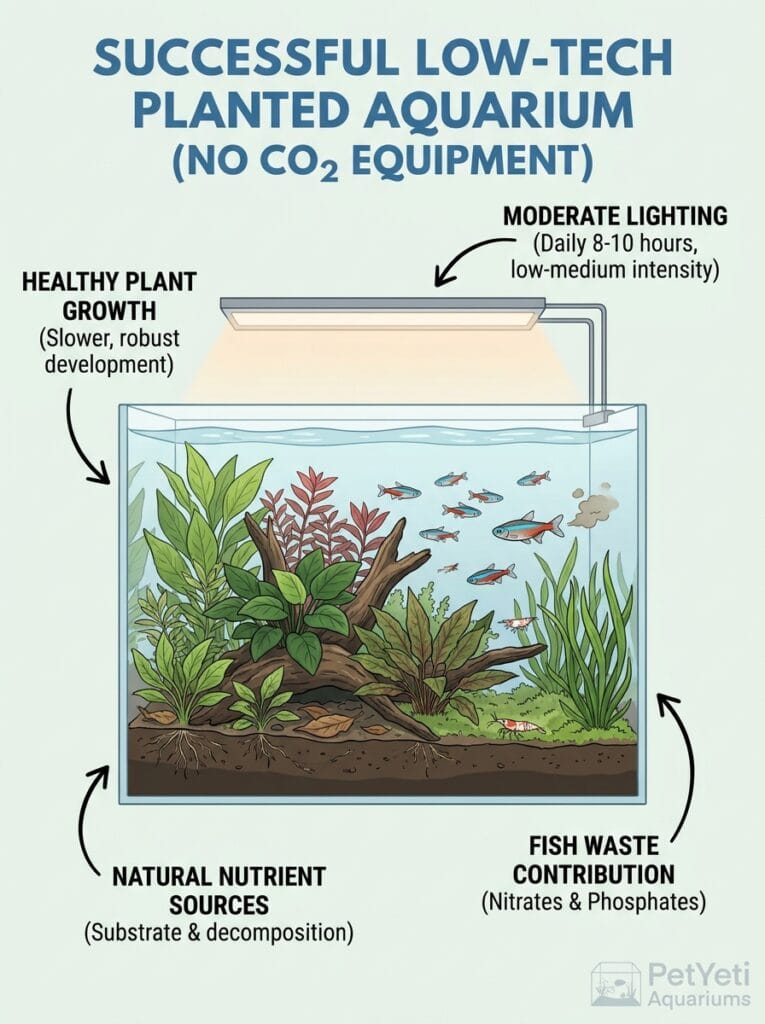
These aquariums rely on:
- Natural carbon sources
- Fish waste
- Regular maintenance
- Balanced lighting
- Consistent water conditions
In fact, some of the most beginner-friendly plants in the hobby thrive without supplemental CO₂.
Real-Life Example
A community aquarium with Anubias, Java Fern, and Cryptocorynes may grow steadily for years without a CO₂ system.
The growth might be slower, but the plants remain healthy and attractive.
What to Expect
Without CO₂, growth is usually slower and easier to manage.
For many hobbyists, that’s actually a benefit.
The Best Aquarium Plants for Tanks Without CO₂
Choosing the right plants makes a huge difference.
Some plants naturally adapt better to low-tech aquariums than others.
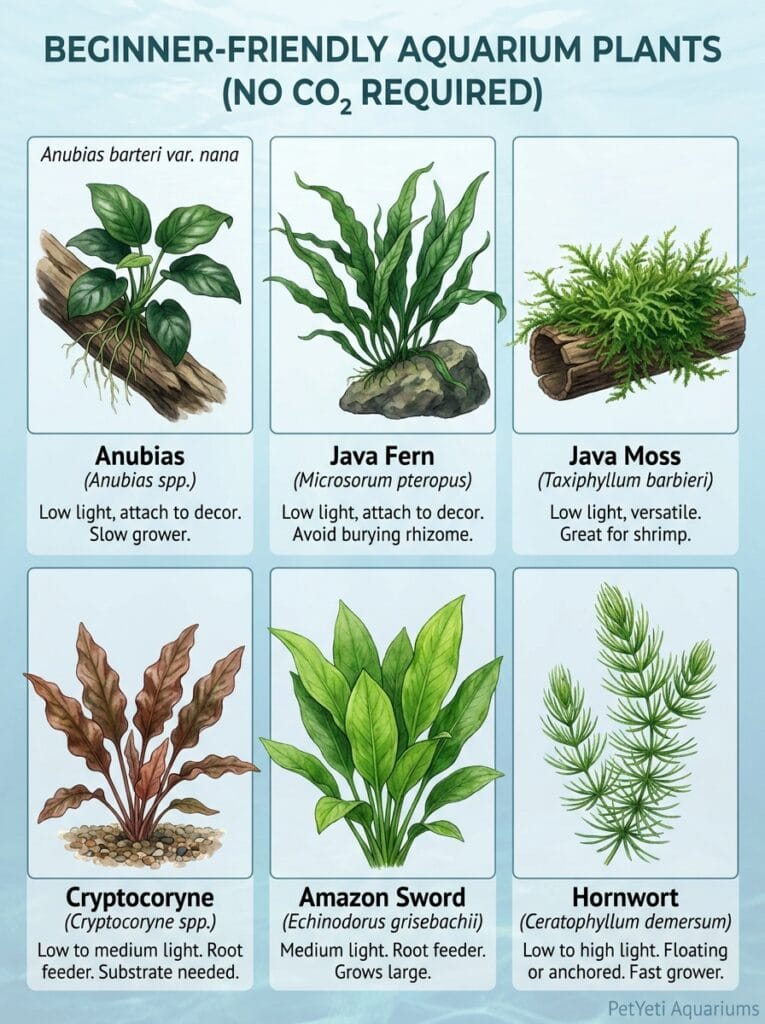
Excellent No-CO₂ Plants
| Plant | Difficulty |
|---|---|
| Anubias | Easy |
| Java Fern | Easy |
| Java Moss | Easy |
| Cryptocoryne | Easy |
| Amazon Sword | Easy |
| Hornwort | Easy |
| Water Sprite | Easy |
These species are popular because they’re forgiving and don’t require specialized equipment.
Real-Life Example
Many beginners start with Anubias because it tolerates a wide range of conditions while growing steadily without demanding constant attention.
PetYeti Tip
Plant selection matters more than equipment.
Choosing suitable plants often has a greater impact than adding expensive gear.
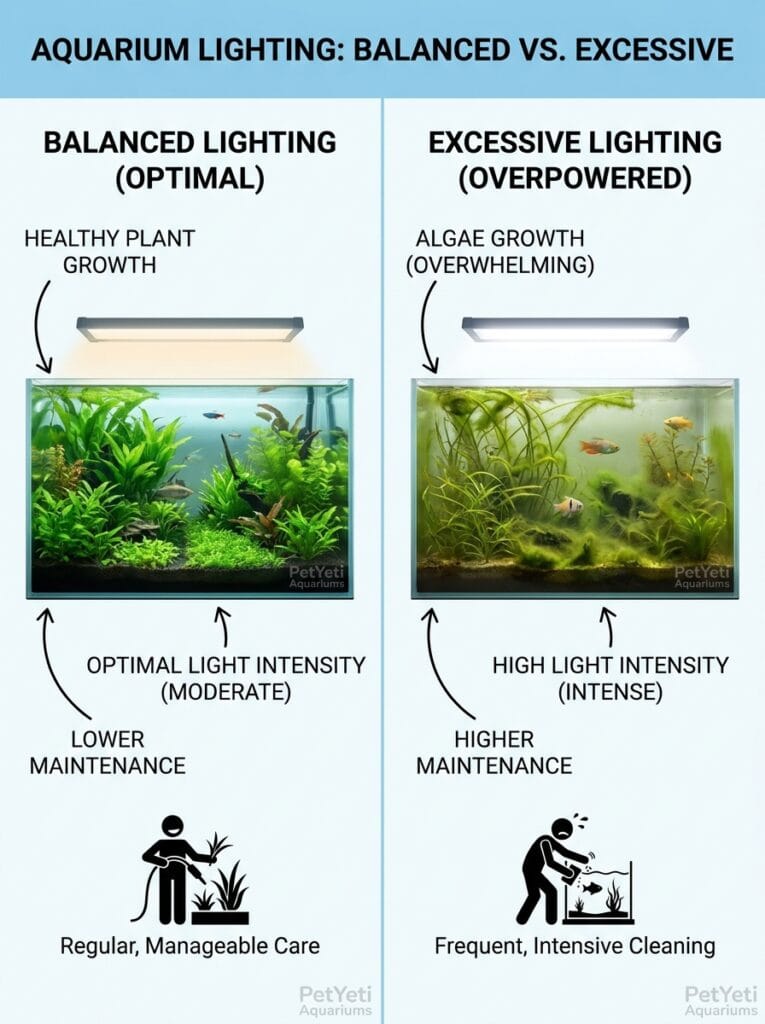
Why Too Much Light Can Cause Problems
One of the biggest mistakes beginners make is assuming more light automatically means healthier plants.
Without CO₂, excessive lighting can actually create problems.
Why?
Because strong lighting increases plant demand for carbon dioxide and nutrients.
When those resources aren’t available, algae often takes advantage.
Signs of Excessive Lighting
- Rapid algae growth
- Green water
- Hair algae
- Plants struggling despite bright lighting
Real-Life Example
A hobbyist upgrades to a powerful light designed for high-tech aquascapes but doesn’t add CO₂. Within weeks, algae begins appearing throughout the aquarium.
The issue isn’t the plants.
The system has become unbalanced.
What to Expect
Moderate lighting usually produces better long-term results in low-tech planted tanks.
How Fish Help Aquarium Plants Grow
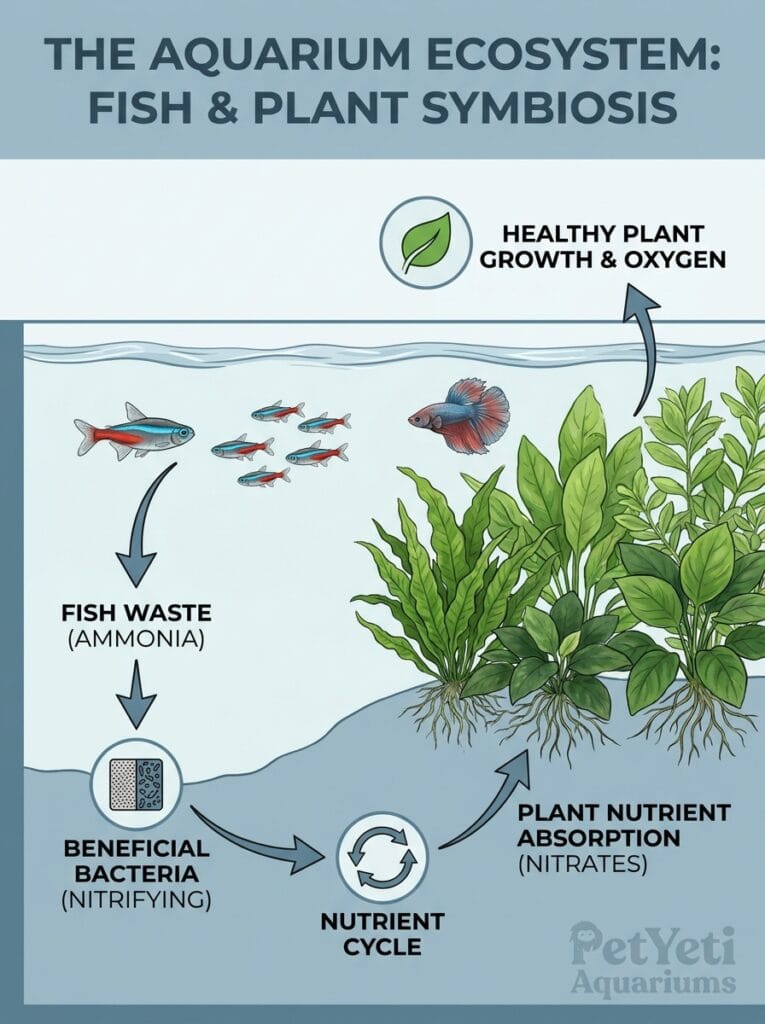
One of the reasons low-tech planted aquariums work so well is that fish naturally contribute nutrients.
As fish eat and produce waste, nutrients enter the aquarium ecosystem.
Beneficial bacteria help break down this waste into forms that plants can use.
This creates a simple, natural cycle.
Fish and Plants Work Together
| Fish Provide | Plants Help With |
|---|---|
| Nutrients | Water quality |
| Organic waste | Nutrient absorption |
| Carbon dioxide | Oxygen production |
| Biological activity | Natural stability |
Real-Life Example
A lightly stocked aquarium with healthy fish often supports beginner plants surprisingly well because nutrients are continuously being recycled through the system.
What to Expect
Healthy fish populations and healthy plants often complement each other, creating a more stable aquarium environment.
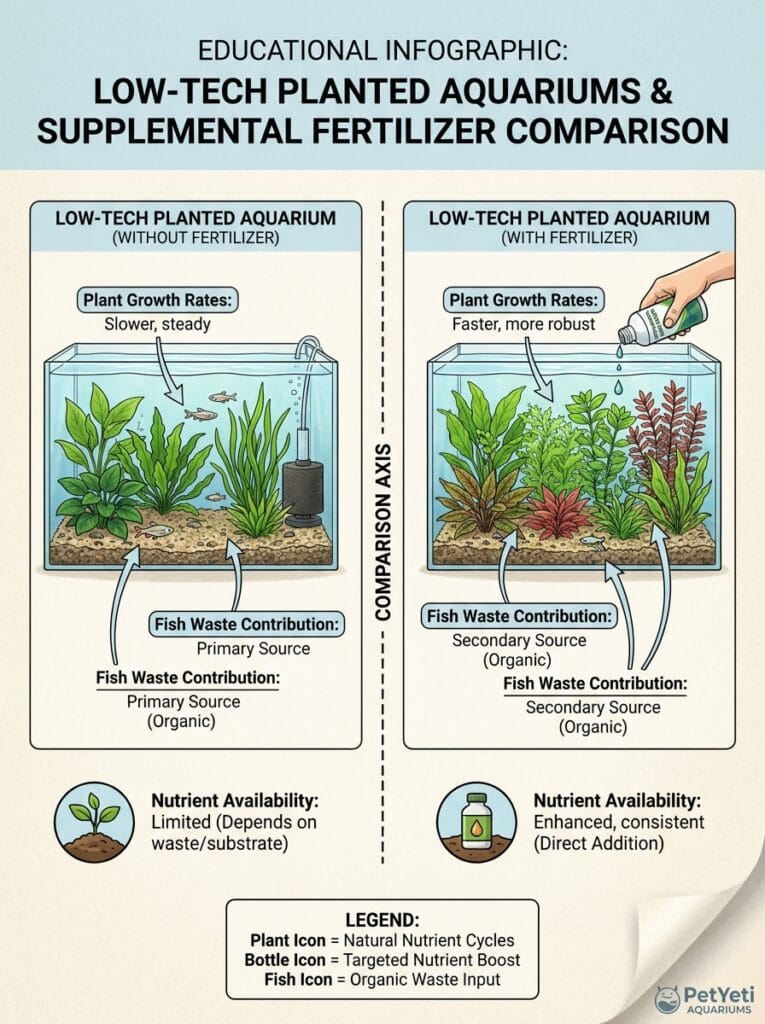
Do Low-Tech Aquariums Need Fertilizer?
Sometimes.
But not always.
Many beginners assume that every planted aquarium requires a complicated fertilization schedule.
That’s usually not the case.
Several factors influence nutrient demand:
- Plant species
- Fish population
- Substrate type
- Lighting intensity
- Plant density
When Fertilizer May Help
✅ Yellowing leaves
✅ Slow growth
✅ Pale coloration
✅ Heavy plant growth
When You Might Not Need It
✅ Lightly planted tanks
✅ Established aquariums with fish
Real-Life Example
An aquarium containing Anubias and Java Fern may grow successfully for months using only nutrients naturally produced by fish and organic matter.
PetYeti Tip
Don’t assume you need fertilizer simply because someone online says you do.
Observe your plants first.
Common Mistakes When Growing Aquarium Plants Without CO₂
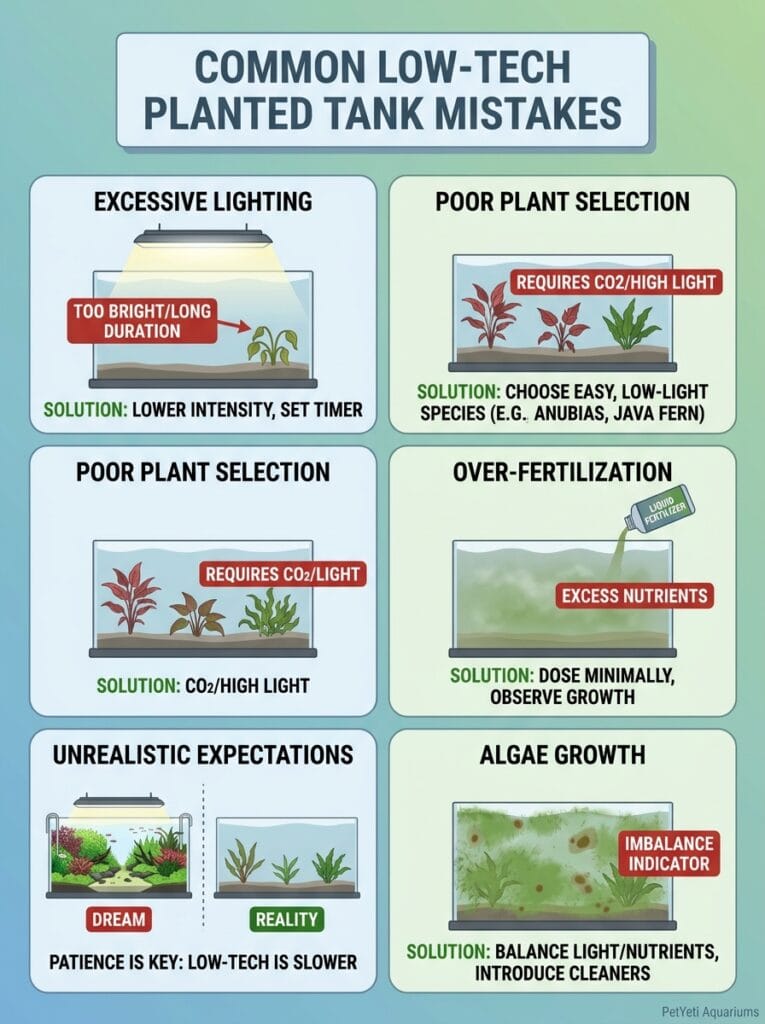
Most low-tech planted tank failures aren’t caused by a lack of CO₂.
They’re usually caused by unrealistic expectations or poor balance.
Common Mistakes
❌ Choosing advanced plants that require high-tech setups
❌ Using excessive lighting
❌ Over-fertilizing
❌ Making frequent changes
❌ Expecting rapid growth
❌ Ignoring plant selection
Real-Life Example
A beginner purchases carpeting plants commonly used in competition aquascapes and becomes frustrated when they struggle without CO₂. The issue isn’t their aquarium—it’s that the plants were not suited to a low-tech setup.
What to Remember
Plant choice often determines success more than equipment.
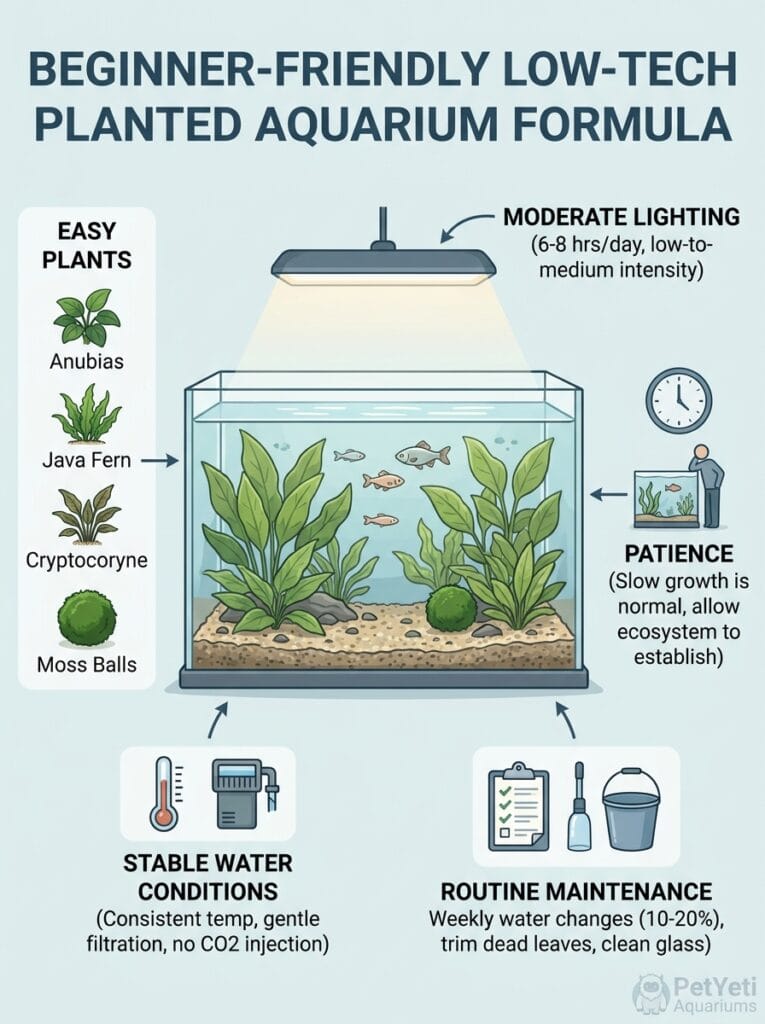
A Simple Formula for Success Without CO₂
If you’re building your first planted aquarium, keep things simple.
Many successful low-tech aquariums follow the same basic formula:
The PetYeti Low-Tech Formula
Easy Plants + Moderate Lighting + Stable Water Conditions + Patience = Success
That’s it.
No complicated equipment.
No pressurized systems.
No chasing perfect numbers.
Real-Life Example
Some of the most beautiful home aquariums feature simple plants, basic equipment, and years of steady growth rather than constant upgrades.
Why This Works
Consistency usually beats complexity.
Many hobbyists discover they enjoy the hobby more when maintenance stays simple and manageable.
Related PetYeti Guides
Growing aquarium plants without CO2 is easier when you choose hardy plants, keep lighting stable, and support plant growth with simple nutrients when needed. These guides can help you build a low-tech planted tank without overcomplicating it:
CONCLUSION
Growing aquarium plants without CO₂ is not only possible—it’s how many hobbyists successfully enjoy planted tanks for years.
While CO₂ can accelerate growth, it isn’t required for most beginner-friendly aquariums.
Choosing suitable plants, providing moderate lighting, maintaining stable conditions, and staying patient are often far more important than adding expensive equipment.
For many home aquariums, slower growth is actually an advantage.
Maintenance becomes easier.
Plants remain manageable.
And the aquarium keeps the calm, relaxing atmosphere that many people are trying to create in the first place.
If your goal is a beautiful planted aquarium for your living room, bedroom, office, or apartment, a low-tech approach may be exactly what you need.
FAQs
Can aquarium plants survive without CO₂?
Yes. Many popular aquarium plants grow successfully without supplemental CO₂.
What are the best aquarium plants without CO₂?
Anubias, Java Fern, Java Moss, Cryptocoryne, Amazon Sword, Hornwort, and Water Sprite are all excellent choices.
Will aquarium plants grow slower without CO₂?
Usually yes. Growth is often slower, but many hobbyists find this easier to manage.
Do low-tech planted tanks need fertilizer?
Sometimes. It depends on the plants, fish population, and nutrient availability within the aquarium.
Is CO₂ necessary for beginners?
No. Most beginners can grow many beautiful plants without investing in a CO₂ system.
Can I have a beautiful planted aquarium without CO₂?
Absolutely. Many stunning planted aquariums rely entirely on low-tech methods.