
If you’ve started adding live plants to your aquarium, you’ve probably come across fertilizers.
Some aquarium guides make it sound like fertilizers are absolutely essential.
Others claim fish waste provides everything plants need.
So who’s right?
The truth is somewhere in the middle.
Some aquarium plants can grow surprisingly well without added fertilizer, especially in established aquariums with fish. Other plants may struggle, develop yellow leaves, or stop growing if they don’t receive additional nutrients.
The key is understanding what your plants need and when they actually need it.
In this guide, we’ll explain whether aquarium plants need fertilizer, how to tell if your plants are lacking nutrients, and how beginners can avoid some of the most common fertilizing mistakes.
- Why Aquarium Plants Need Nutrients
- Can Aquarium Plants Grow Without Fertilizer?
- When Do Aquarium Plants Actually Need Fertilizer?
- Not All Aquarium Plants Feed the Same Way
- Do Low-Tech Aquariums Need Fertilizer?
- Can Too Much Fertilizer Cause Problems?
- A Simple Fertilizer Strategy for Beginners
- Common Fertilizer Mistakes Beginners Make
- CONCLUSION
- FAQs
As an Amazon Associate, PetYeti earns from qualifying purchases. This comes at no additional cost to you and helps support the site. We only recommend products we genuinely believe can help create healthier and more enjoyable aquariums.
Why Aquarium Plants Need Nutrients
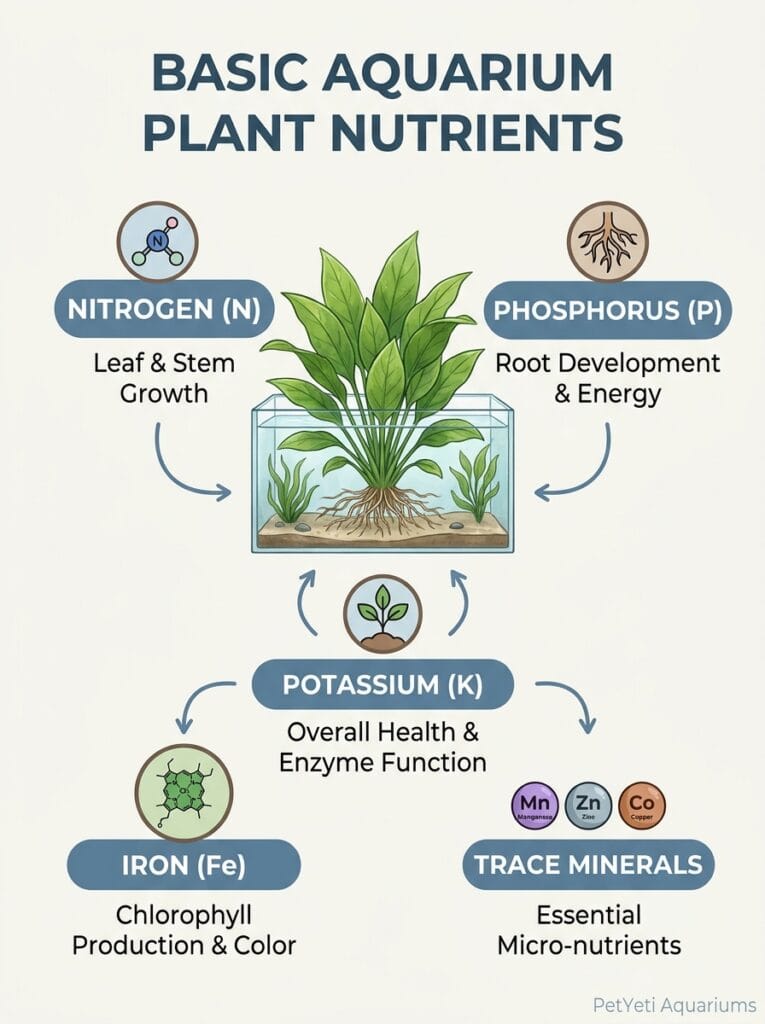
Just like garden plants and houseplants, aquarium plants need nutrients to grow.
These nutrients support everything from leaf production to root development and overall plant health.
Some of the most important nutrients include:
Major Nutrients
| Nutrient | Supports |
|---|---|
| Nitrogen (N) | Leaf growth |
| Phosphorus (P) | Root development |
| Potassium (K) | Overall plant health |
Trace Nutrients
| Nutrient | Supports |
|---|---|
| Iron | Leaf coloration |
| Magnesium | Photosynthesis |
| Manganese | Plant metabolism |
Without access to these nutrients, plants may survive for a while but often won’t thrive.
Real-Life Example
A beginner may notice their Java Fern stays alive for months but produces very little new growth. In many cases, the plant isn’t dying—it simply lacks some of the nutrients needed for stronger growth.
What to Expect
Healthy plants typically produce new leaves, stronger roots, and richer coloration over time.
Can Aquarium Plants Grow Without Fertilizer?
Yes, many aquarium plants can grow without added fertilizer.
In fact, countless beginners successfully grow live plants without using any fertilizers at all.
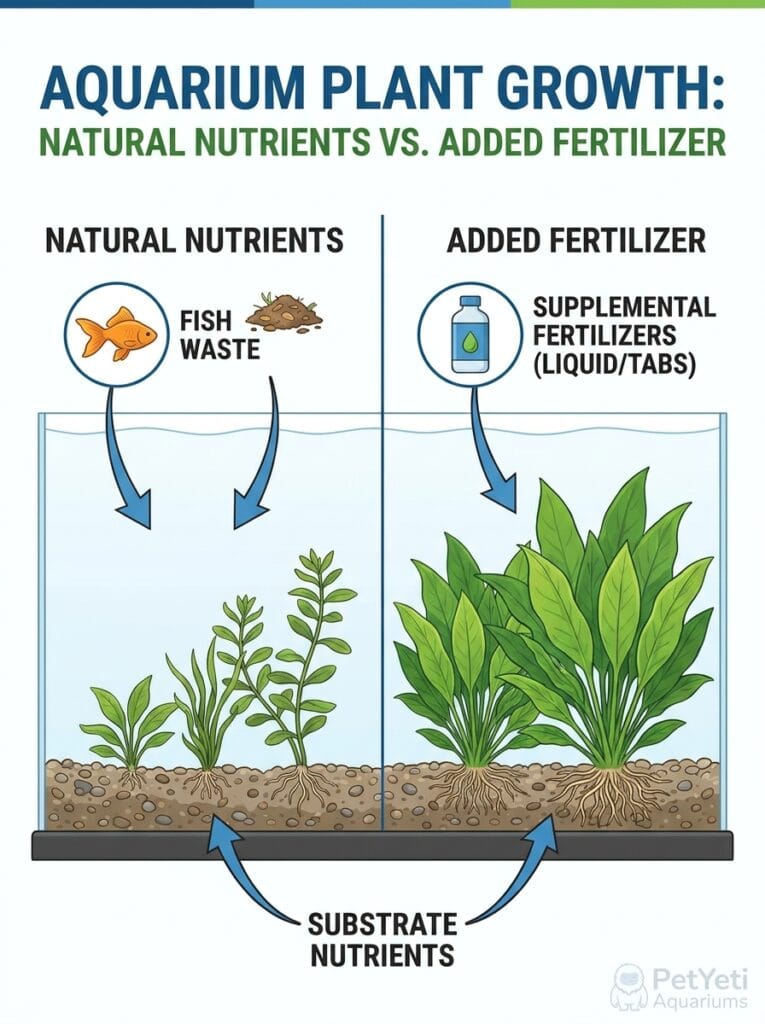
Plants may obtain nutrients from:
- Fish waste
- Uneaten food
- Decaying organic matter
- Nutrient-rich substrates
- Tap water minerals
This is especially true for hardy beginner plants.
Examples of Plants That Often Grow Without Fertilizer
| Plant | Difficulty |
|---|---|
| Java Fern | Easy |
| Anubias | Easy |
| Java Moss | Easy |
| Hornwort | Easy |
| Water Sprite | Easy |
Real-Life Example
A lightly planted community aquarium with healthy fish often provides enough nutrients for beginner-friendly plants to grow reasonably well without additional fertilizers.
What to Expect
Plants may survive and grow slowly without fertilizer, but growth rates often improve when nutrients are balanced correctly.
When Do Aquarium Plants Actually Need Fertilizer?
Fertilizer becomes more important when plants begin consuming nutrients faster than the aquarium can naturally replace them.
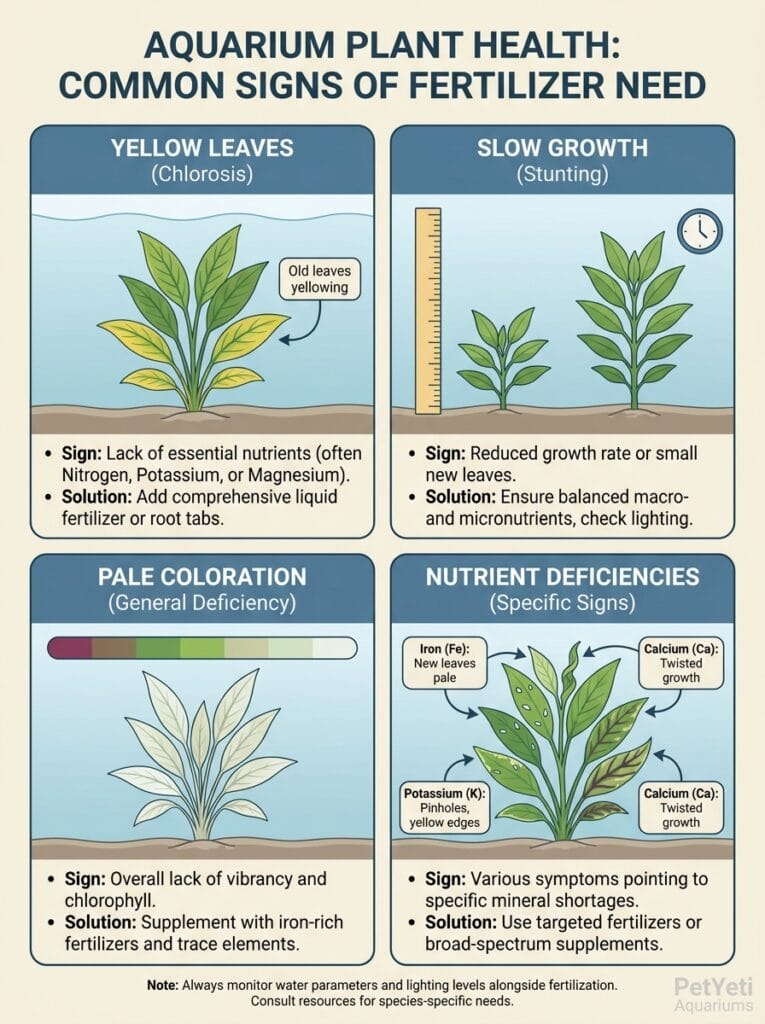
Common signs include:
Possible Nutrient Deficiency Symptoms
✅ Slow or stalled growth
✅ Small new leaves
✅ Pale coloration
✅ Holes appearing in leaves
✅ Weak root development
Real-Life Example
A hobbyist may add several fast-growing stem plants and notice that growth slows dramatically after a few weeks. The plants have likely exhausted some of the available nutrients in the aquarium.
Why This Matters
Many plant problems aren’t caused by lighting or water quality.
Sometimes the plants are simply hungry.
Not All Aquarium Plants Feed the Same Way
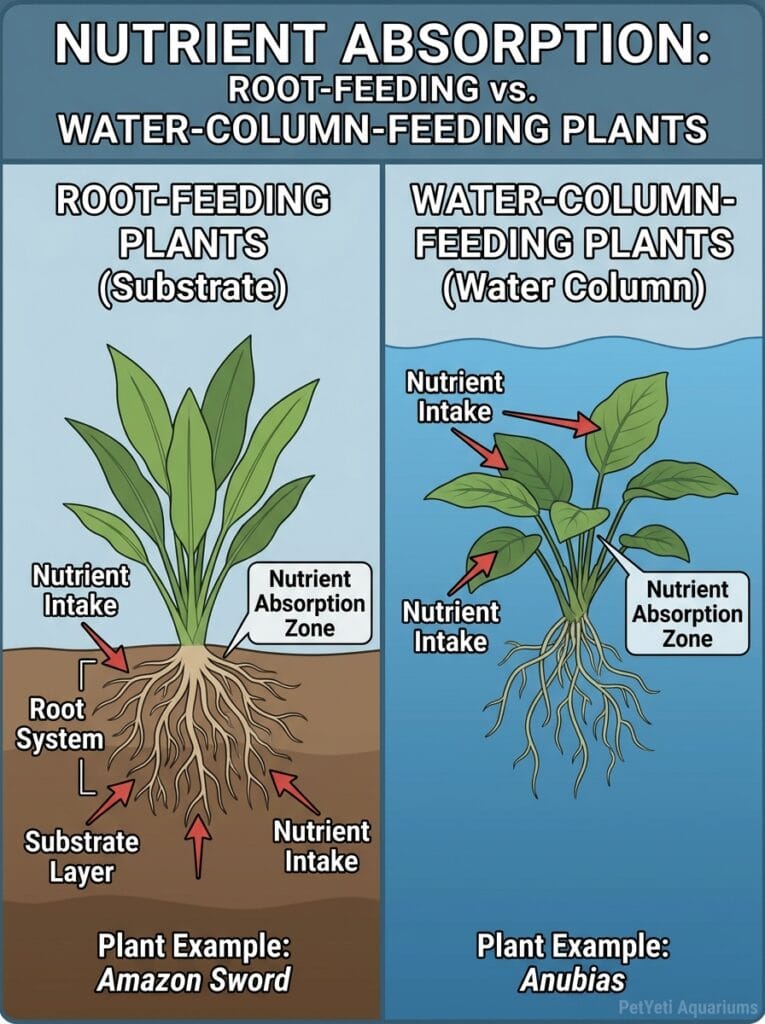
One reason fertilizer advice can be confusing is that different plants absorb nutrients differently.
Some plants primarily feed through their roots.
Others absorb nutrients directly from the water.
Root Feeders
Examples include:
- Amazon Sword
- Cryptocoryne
- Vallisneria
These plants often benefit from nutrient-rich substrates or root tabs.
⭐ PetYeti Pick: Root Feeder Support
Recommended Option: Aquarium Root Tabs
Best For:
✓ Amazon Sword
✓ Cryptocoryne
✓ Vallisneria
✓ Root-feeding aquarium plants
Why We Like It:
✓ Helps feed plants through the substrate
✓ Useful for heavy root feeders
✓ Beginner-friendly
✓ Easy to place near plant roots
PetYeti Take:
Root tabs are especially helpful when your aquarium plants feed mainly through their roots. They can make a big difference for plants like Amazon Swords and Cryptocoryne without making the whole tank more complicated.
Water Column Feeders
Examples include:
- Java Fern
- Anubias
- Hornwort
These plants often benefit more from liquid fertilizers.
Helpful Plant Growth Option
Recommended Option: Beginner Aquarium Liquid Fertilizer
Best For:
✓ Java Fern
✓ Anubias
✓ Hornwort
✓ Water-column-feeding plants
Why We Like It:
✓ Easy to dose
✓ Supports plants that absorb nutrients from the water
✓ Useful in low-tech planted tanks
✓ Simple beginner-friendly routine
PetYeti Take:
Liquid fertilizer can be helpful when plants are growing slowly, looking pale, or struggling to produce healthy new leaves. The key is starting slowly instead of assuming more fertilizer is always better.
Real-Life Example
A beginner may add liquid fertilizer for an Amazon Sword and see little improvement because the plant is actually seeking nutrients through its root system.
What to Expect
Understanding how your plants feed helps you choose the right fertilization strategy.
Do Low-Tech Aquariums Need Fertilizer?
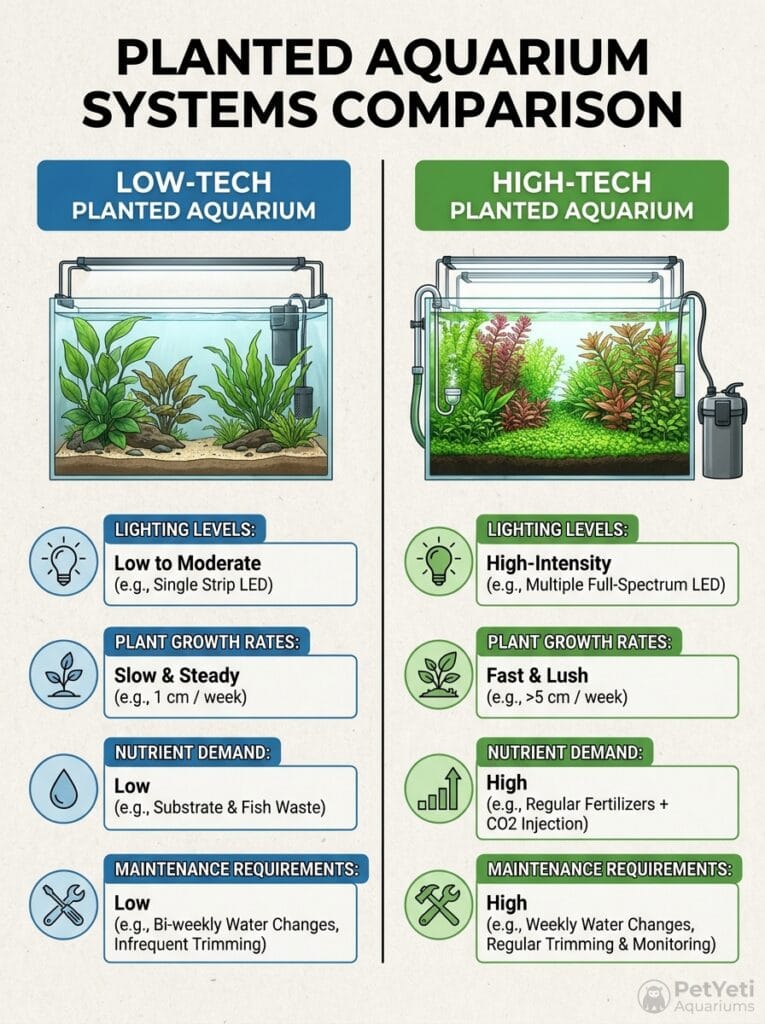
One of the biggest misconceptions in fishkeeping is that every planted aquarium requires a complicated fertilization schedule.
For many low-tech aquariums, that’s simply not true.
Low-tech tanks typically have:
- Moderate lighting
- No CO₂ injection
- Hardy plant species
- Slower plant growth
Because plants grow more slowly, their nutrient demand is often lower.
Real-Life Example
A beginner keeping Anubias, Java Fern, and Java Moss in a community aquarium may see healthy growth for months without adding any fertilizer at all.
When Fertilizer Helps
Even low-tech aquariums can eventually benefit from fertilization if:
- Plant growth slows noticeably
- Leaves become pale
- Yellowing develops
- The aquarium contains many plants
What to Expect
Many successful low-tech aquariums use little or no fertilizer initially and only supplement nutrients when plants show signs of needing help.
Can Too Much Fertilizer Cause Problems?
Yes.
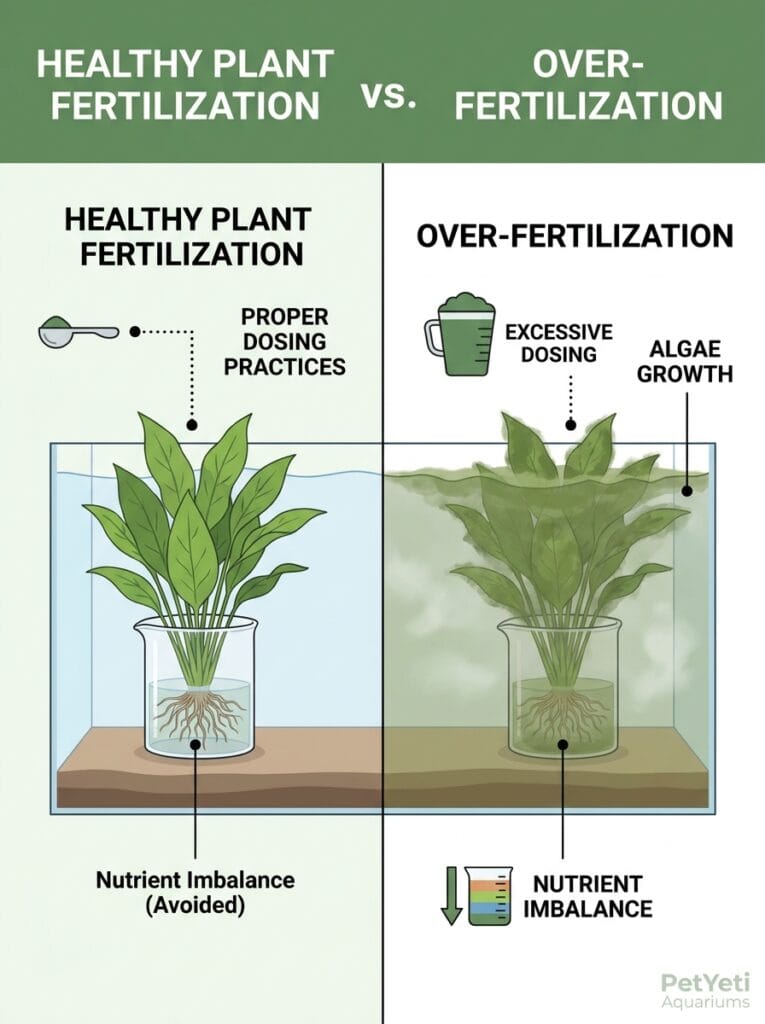
Adding more fertilizer does not automatically create healthier plants.
In fact, excessive fertilization is one of the most common beginner mistakes.
When nutrients accumulate faster than plants can use them, algae often takes advantage of the excess.
Potential Problems From Over-Fertilizing
❌ Increased algae growth
❌ Water quality issues
❌ Nutrient imbalances
❌ Wasted money
❌ Unnecessary maintenance
Real-Life Example
A new hobbyist noticed slight yellowing on a few leaves and immediately doubled their fertilizer dosage. Within a couple of weeks, green algae began appearing on the glass and decorations.
The issue wasn’t a lack of fertilizer anymore—it was too much.
PetYeti Tip
It’s usually easier to increase fertilizer slowly than to correct problems caused by excessive dosing.
A Simple Fertilizer Strategy for Beginners
Beginners often feel pressured to buy multiple fertilizers immediately.
In most cases, that’s unnecessary.
A simpler approach usually works better.
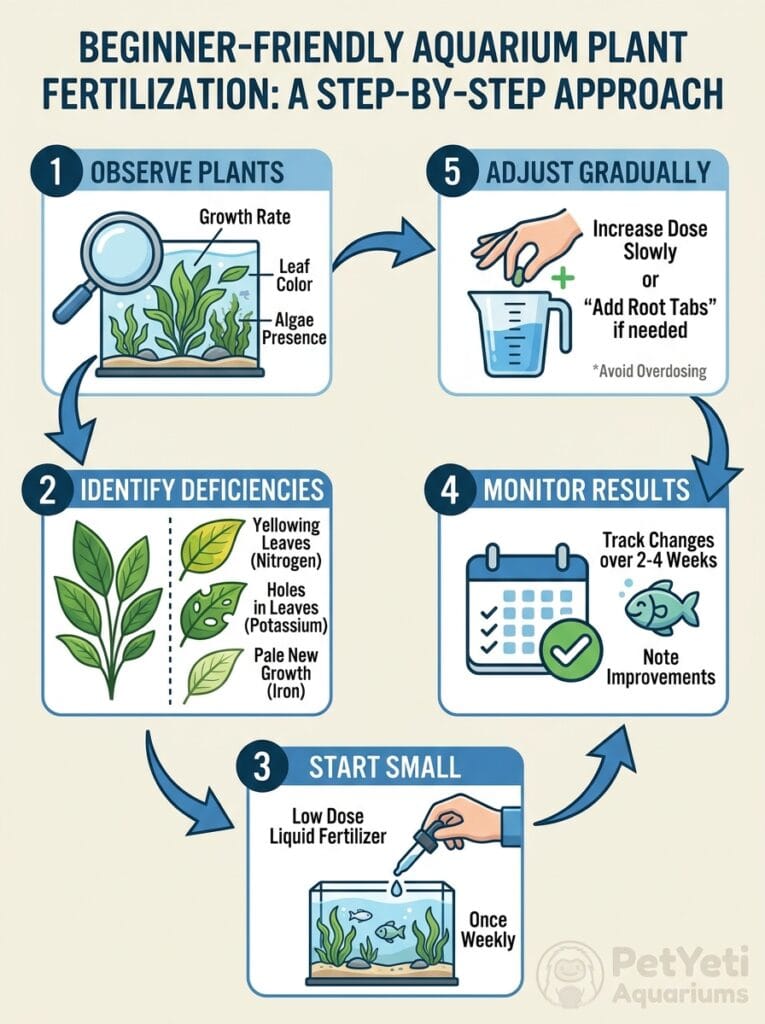
Step 1: Start With Easy Plants
Plants like:
- Anubias
- Java Fern
- Java Moss
- Hornwort
are forgiving and don’t demand aggressive fertilization.
Step 2: Observe Growth
Watch for:
- New leaves
- Healthy coloration
- Root development
- Consistent growth
Step 3: Add Fertilizer Only When Needed
If plants show signs of nutrient deficiencies, begin with a conservative dosing schedule.
Step 4: Make Small Adjustments
Avoid changing multiple variables at once.
Real-Life Example
Many successful planted tanks evolve slowly. Owners make small adjustments, observe results, and let the aquarium stabilize naturally.
Why This Works
Plants usually respond gradually.
Patience often produces better results than constantly changing products and routines.
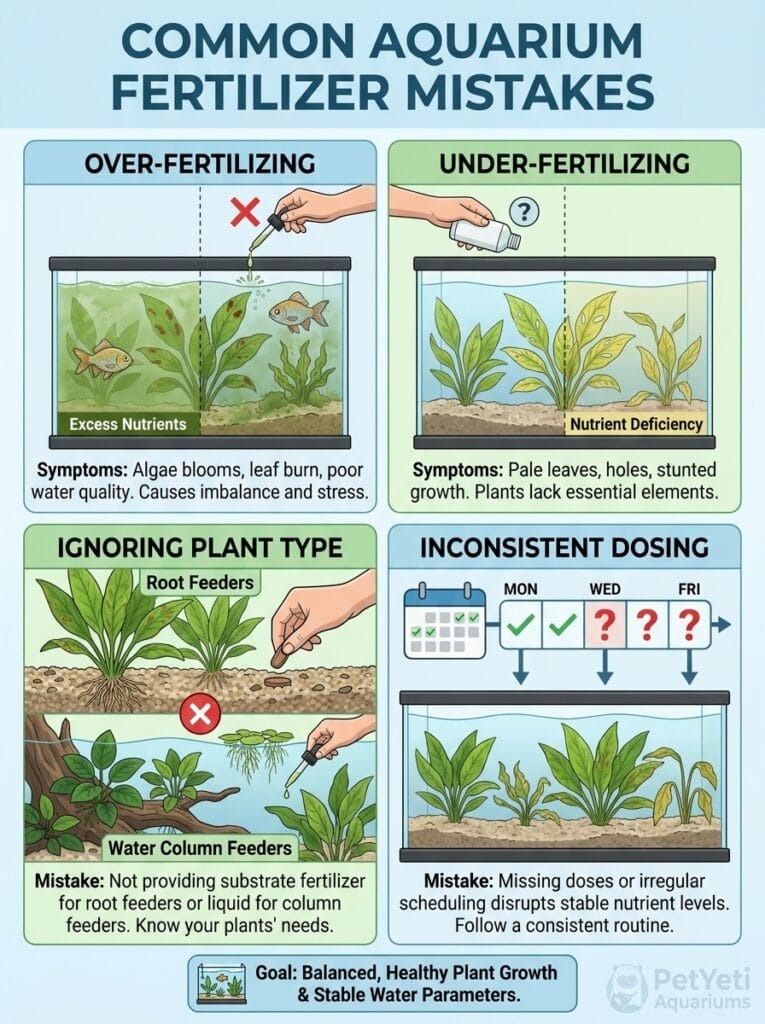
Common Fertilizer Mistakes Beginners Make
Most plant fertilization problems come from a handful of common mistakes.
Mistakes to Avoid
❌ Adding fertilizer before determining whether plants actually need it
❌ Using fertilizer to compensate for poor lighting
❌ Ignoring the difference between root feeders and water-column feeders
❌ Expecting instant results
❌ Drastically increasing doses after minor plant issues
❌ Chasing perfect growth too quickly
Real-Life Example
Many aquarium owners assume every yellow leaf means a nutrient deficiency. In reality, older leaves naturally die off over time, especially when plants are adapting to a new aquarium.
What to Remember
Healthy planted aquariums are usually built through consistency, not constant intervention.
Related PetYeti Guides
Aquarium plant fertilizer makes more sense when you know whether your plants feed mostly from the water, the substrate, or both.
Not sure which fertilizer type to use? Read root tabs vs liquid fertilizer.
Yellowing leaves? See why aquarium plants turn yellow.
Brown leaves or weak growth? Read why aquarium plants turn brown.
Keeping easy plants? See our low-light aquarium plants guide.
Growing plants in a betta tank? Read our guide to creating a beautiful planted betta tank.
CONCLUSION
So, do aquarium plants need fertilizer?
Sometimes.
But not always.
Many beginner-friendly plants can grow surprisingly well using nutrients that already exist within a healthy aquarium.
As plant growth increases, however, nutrient demands often increase as well.
The key is learning to observe your plants.
Healthy growth, vibrant coloration, and steady development usually indicate that things are working well.
If signs of nutrient deficiencies appear, fertilizer can be a valuable tool.
Just remember that more isn’t always better.
A simple, patient approach often produces the healthiest plants and the most enjoyable aquarium experience.
And that’s exactly what PetYeti is all about—creating beautiful, peaceful aquariums without making the hobby more complicated than it needs to be.
FAQs
Do all aquarium plants need fertilizer?
No. Many beginner-friendly plants can grow successfully without added fertilizer, especially in established aquariums with fish.
Can fish waste provide enough nutrients for aquarium plants?
Sometimes. Fish waste supplies nutrients that many plants can use, although heavily planted aquariums may eventually require additional supplementation.
What happens if aquarium plants don’t get enough nutrients?
Growth may slow, leaves can yellow, coloration may fade, and plants may struggle to produce new growth.
How do I know if my aquarium plants need fertilizer?
Common signs include yellow leaves, slow growth, pale coloration, holes in leaves, and weak root development.
Is liquid fertilizer or root tabs better?
It depends on the plant. Some species absorb nutrients primarily through their roots, while others absorb nutrients from the water column. We’ll cover this in the next article.
Can too much fertilizer harm an aquarium?
Yes. Excess nutrients can contribute to algae growth and nutrient imbalances.