
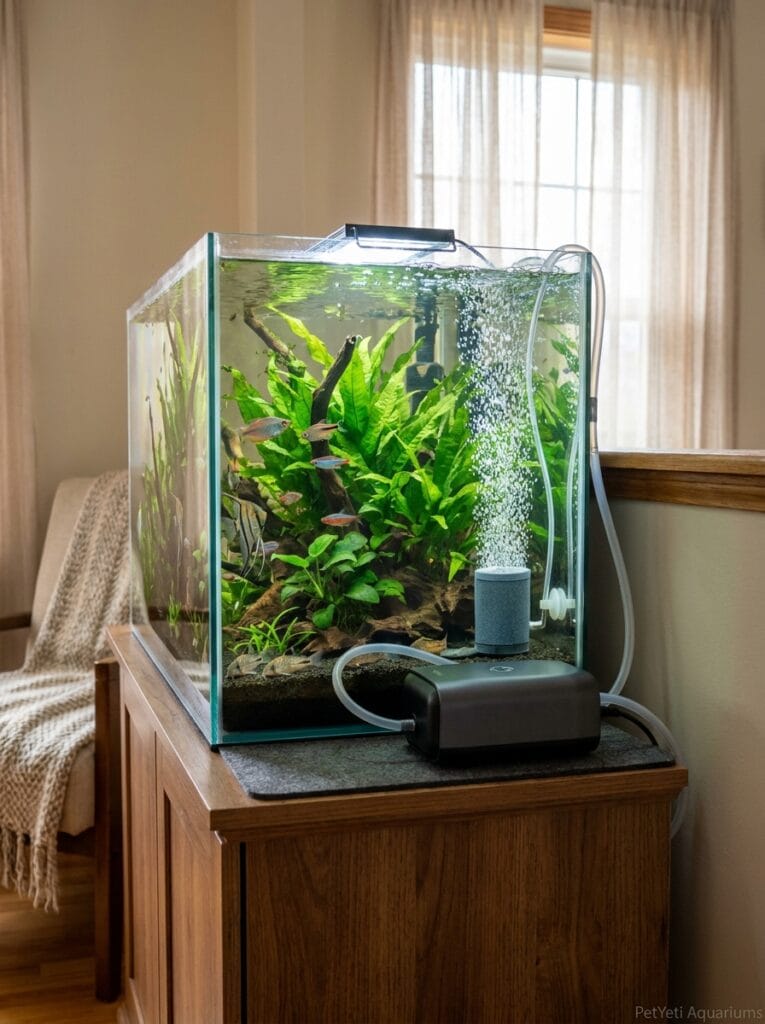
Choosing an aquarium air pump is mostly about matching the pump to what you actually want it to do.
An air pump can power a sponge filter, run an air stone, or add extra surface movement to an aquarium. But not every tank needs one, and a pump that is too strong can create unnecessary water movement or noise.
For beginners, the important things to consider are tank size, air pressure, intended use, adjustable airflow, and noise.
In this guide, we’ll explain what aquarium air pumps actually do, when you need one, what features matter, and how to choose a pump that fits your aquarium.
Quick Answer
For a small aquarium running a single sponge filter or air stone, a compact air pump may be all you need. Larger aquariums or setups running multiple air-powered devices may require a pump with greater airflow and pressure.
The right choice depends less on buying the most powerful pump and more on matching the pump to the equipment you plan to run.
| Air Pump | Best For | General Use | Top Pick Jump Link |
| Hygger Silent Mini Air Pump | Desktop and small aquariums | Small sponge filters or air stones | Jump to Review |
| Tetra Whisper Air Pump | General beginner setups | Sponge filters and air stones | Jump to Review |
| AquaMiracle USB Air Pump | Compact or backup setups | Small air-powered equipment | Jump to Review |
| Hygger Dual Outlet Air Pump | Larger or multiple-device setups | Multiple sponge filters or air stones | Jump to Review |
Always check the manufacturer’s current specifications before buying, particularly the recommended aquarium size, airflow, and pressure rating.
- What to Look For in an Aquarium Air Pump
- What Does an Aquarium Air Pump Actually Do?
- The Best Aquarium Air Pumps for Beginners
- Do All Aquariums Need an Air Pump?
- How to Set Up Your Air Pump (And Keep It Quiet)
- When an Air Pump Is Most Helpful
- Features Beginners Should Look For
- Quiet vs Loud Air Pumps
- Common Air Pump Mistakes
- Don't Forget the Airline Tubing
- CONCLUSION
- FAQs
What to Look For in an Aquarium Air Pump
Buying an air pump seems simple, but getting the wrong size or style can lead to annoying hums or weak airflow. Here are four key things to keep in mind before you pick one out:
1. Motor Type: Piezoelectric vs. Diaphragm
- Piezoelectric (Nano / USB Pumps): These use a tiny ceramic element rather than a traditional vibrating mechanical motor. They are almost completely silent and consume very little power, making them perfect for small tanks under 10 or 15 gallons. However, they lack the raw power needed for deep tanks or multiple air stones.
- Diaphragm Pumps: These use an electromagnet and a rubber diaphragm to push air. They are significantly stronger and can drive multiple sponge filters, long air stones, or deep aquariums. Quality models use heavy rubber feet and thick casings to dampen motor hum.
2. Tank Depth & Airflow Resistance
Air pumps are rated by tank size (e.g., “up to 20 gallons”), but water depth matters just as much. The deeper your aquarium, the more water pressure (backpressure) the pump has to push against. If you have a deep tank or plan to push air through a fine-grained micro-bubble diffuser, choose a pump rated slightly higher than your tank size.
3. Adjustable Flow Controls
Not every setup needs maximum bubbling power. Having an adjustable flow dial gives you precise control over your water surface movement, which is essential if you keep delicate swimmers like long-finned bettas or tiny shrimp.
PetYeti Calm Tip:
Always install an inexpensive check valve in your airline tubing above or near your pump. If the power goes out, water can back-siphon through the tubing and ruin your pump (or flood your floor). A check valve stops back-siphoning instantly.
WHAT TO CHECK FIRST
Before buying an aquarium air pump, check these basics:
- Tank size — small tanks usually need gentle airflow, not maximum power.
- Purpose — sponge filters, air stones, and backup aeration may need different airflow.
- Noise level — important for bedrooms, desks, and apartments.
- Check valve — helps prevent water from siphoning backward into the pump.
- Tubing and air stone — many beginners forget these extra parts.
As an Amazon Associate, PetYeti earns from qualifying purchases. This comes at no additional cost to you and helps support the site. We only recommend products we genuinely believe can help create healthier and more enjoyable aquariums.
What Does an Aquarium Air Pump Actually Do?
Many beginners assume air pumps add oxygen directly to the water through bubbles.
That’s only part of the story.
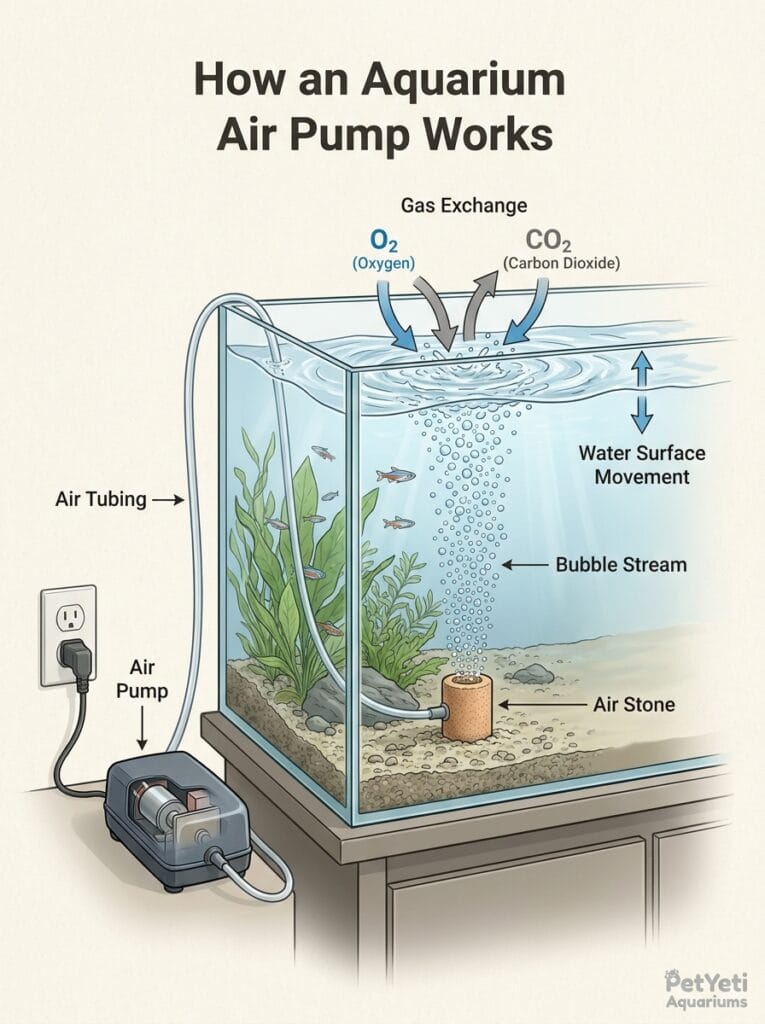
The most important benefit actually comes from water movement. As bubbles rise, they disturb the water surface and increase gas exchange. This allows oxygen to enter the water while carbon dioxide escapes.
Benefits of Air Pumps
✅ Increase surface agitation
✅ Improve gas exchange
✅ Support oxygen levels
✅ Power certain aquarium equipment
✅ Improve water circulation in some setups
Real-Life Example
A heavily stocked aquarium may benefit from additional surface movement during hot summer months when oxygen levels naturally decrease.
What to Remember
The bubbles aren’t the goal. The water movement they create is what matters most.
The Best Aquarium Air Pumps for Beginners
1.⭐ PetYeti Pick: Hygger Mini Air Pump
Best For:
Small aquariums, desktop setups, betta or shrimp tanks, and other setups that need a compact air pump.
Why We Like It:
- Compact design
- Low power consumption
- Piezoelectric pump design rather than a conventional motor
- Manufacturer-rated noise below 35 dB
- Includes an air stone and airline tubing
- Suitable for small aquariums
Hygger lists this mini pump at 1.5 watts with a maximum airflow of 420 mL/min and a recommended application of up to 15 gallons. The manufacturer also describes its piezoelectric design as quieter than traditional aquarium air pumps.
PetYeti Take:
This is a good option to consider when you need a small air pump and want to keep equipment compact and relatively quiet.
Who Should Skip It:
Skip this type of mini pump if you need to run several air-powered devices or need substantially more airflow and pressure. A larger pump may be a better fit.
2. ⭐ PetYeti Pick: Tetra Whisper Air Pump
Best For:
Beginner aquariums where you want a conventional air pump with a range of available sizes.
Why We Like It:
- Sound-dampening design
- Rubber feet to reduce vibration transfer
- Suspended motor design
- Multiple size options
- Suitable for air stones and other air-powered equipment
Tetra’s Whisper range uses a dome-shaped design, sound-dampening chambers, rubber feet, and a suspended motor to help reduce noise. The range includes models for aquariums from 10 to 100 gallons.
PetYeti Take:
The Whisper is a straightforward option for beginners who want a conventional air pump with several size choices rather than a particularly small or specialized pump.
Who Should Skip It:
If you’re setting up a very small aquarium and only need a compact pump for one small air-powered device, a mini pump may be more appropriate.
3. ⭐ PetYeti Pick: Compact USB Air Pump
Recommended Option: AquaMiracle USB Air Pump
Best For:
Small aquarium setups, quarantine tanks, portable setups, and backup aeration.
Why We Like It:
- Compact USB-powered design
- Easy to use with a standard USB power source
- Useful as a small backup air pump
- Takes up very little space
A USB air pump can be particularly useful when you want a compact setup or a simple backup option for air-powered equipment. Because USB pumps vary considerably in airflow and pressure, check the current manufacturer’s or retailer’s specifications before choosing one for a particular aquarium.
PetYeti Take:
The main advantage here is portability and convenience rather than maximum airflow. It’s worth considering when space is limited or you want an inexpensive backup pump available when you need extra aeration.
Who Should Skip It:
Skip a compact USB pump if you need to run multiple air-powered devices, push air into a deeper aquarium, or operate equipment that requires substantial pressure. A larger diaphragm pump may be a better fit.
4. ⭐ PetYeti Pick: Hygger Dual-Outlet Air Pump
Best For:
Larger aquariums or setups where you want to run more than one air-powered device from the same pump.
Why We Like It:
- Two air outlets
- Adjustable airflow
- Multiple power/output options
- Designed to reduce vibration and operating noise
- Useful for multiple sponge filters or air stones
Hygger’s dual-outlet models are designed to supply air to two separate lines, and the airflow can be adjusted to suit different setups. The HG946, for example, is listed with a maximum airflow of 255 GPH, 0.04 MPa pressure, and noise below 30 dB for the 10W model.
PetYeti Take:
This is the type of air pump to consider when a small single-outlet pump isn’t enough for your setup. The dual outlets are useful if you want to run two sponge filters, air stones, or other compatible air-powered equipment.
Who Should Skip It:
If you’re running one small sponge filter or air stone, a dual-outlet pump may simply be more capacity than you need. A smaller pump can be easier and more appropriate for a simple setup.
Do All Aquariums Need an Air Pump?
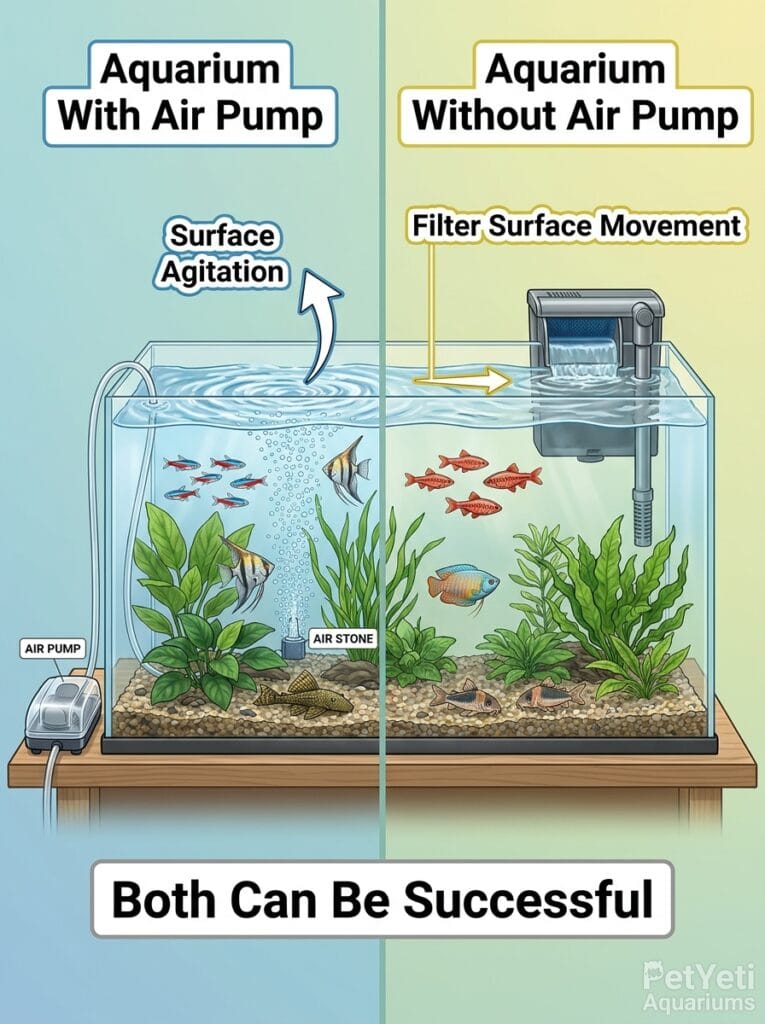
No. An air pump is useful equipment, but it isn’t automatically required for every aquarium.
Many aquariums receive sufficient gas exchange from the water movement created by their filter. A HOB, internal, or other filter that adequately disturbs the surface may already provide the circulation your aquarium needs.
Aquariums That May Not Need an Air Pump
You may not need additional aeration when:
- Your filter provides good surface movement
- The aquarium has a moderate or low bioload
- Water circulation is already adequate
- There is no equipment that requires an air pump
A planted aquarium can also operate successfully without a separate air pump when its overall filtration and circulation are appropriate for the setup.
Aquariums That May Benefit From an Air Pump
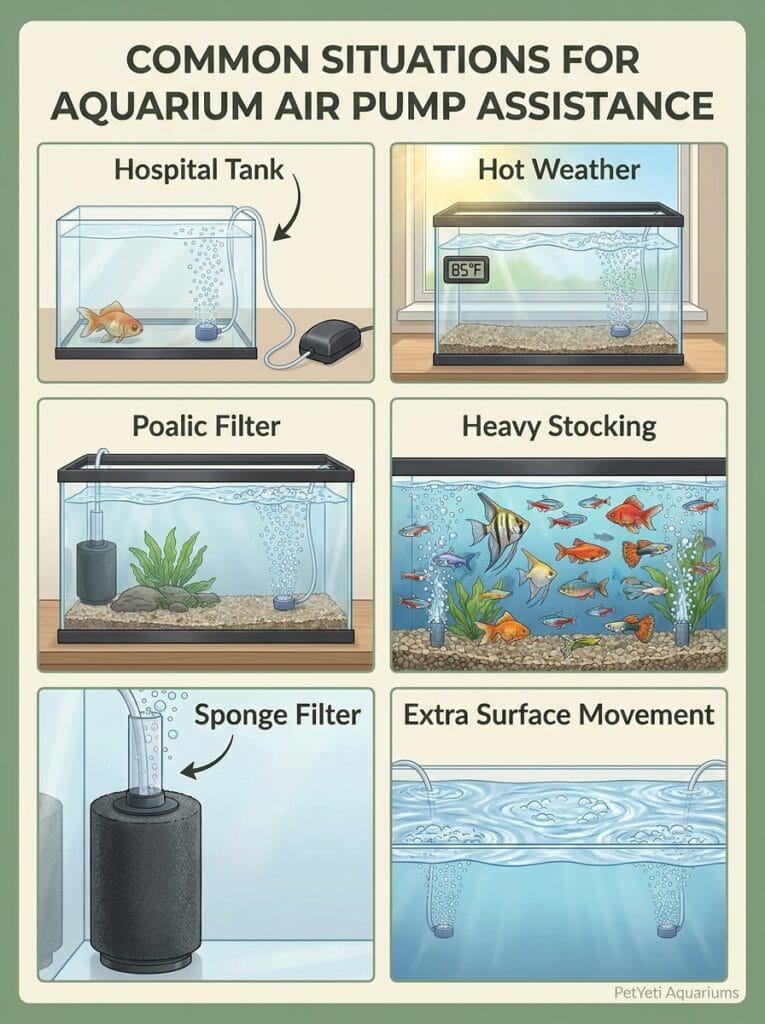
An air pump can be particularly useful for:
- Sponge-filter-only systems
- Hospital or quarantine tanks
- Aquariums with limited surface movement
- Setups with higher oxygen demand
- Additional aeration during unusually warm conditions
The important question isn’t simply whether you have an air pump. It’s whether your aquarium has adequate water movement and gas exchange for the fish and setup you keep.
Real-Life Example
A planted community aquarium with a properly sized filter may not need an additional air pump at all.
A separate aquarium running a sponge filter, however, needs an air pump to operate that filter.
What to Remember
An air pump is a useful tool, not a universal requirement.
How to Set Up Your Air Pump (And Keep It Quiet)
Even a high-quality air pump can make unnecessary noise or lose pressure if it isn’t set up correctly. Here are four quick tips to ensure smooth, quiet operation from day one:
1. Always Install a Check Valve
A check valve is a small, inexpensive plastic piece that allows air to flow in one direction only. Install it inline along your airline tubing between the pump and the tank rim (with the arrow pointing toward the aquarium). If your power goes out or you unplug the pump, the check valve stops water from back-siphoning out of your tank and ruining the motor.
2. Isolate Mechanical Vibration
Most air pump noise comes from the motor vibrating against whatever surface it rests on. To keep it completely silent:
- Place the pump on a small foam pad, mousepad, or folded microfiber towel.
- Hang the pump from a small hook or mount it to the wall behind your tank stand using its hanging loop (if available).
3. Keep the Pump Above the Water Line (If Possible)
Placing your air pump on a shelf or stand higher than the aquarium water surface reduces the amount of backpressure the motor has to work against. This extends the life of the internal rubber diaphragm and keeps air flowing at full strength.
4. Add an Air Valve to Dial in Flow
If your pump doesn’t have an integrated flow dial, insert an inexpensive plastic or metal air control valve into your line. This allows you to bleed off excess air or dial back bubbling intensity for gentle swimmers like bettas and dwarf shrimp.
When an Air Pump Is Most Helpful
An air pump becomes most useful when you have a specific job for it rather than simply adding bubbles to the aquarium.
Running a Sponge Filter
Many sponge filters rely on an air pump to create the water movement that pulls aquarium water through the sponge.
If you’re using a sponge filter, the air pump is part of the filtration system rather than an optional extra.
During Warm Conditions
Warmer water holds less dissolved oxygen than cooler water.
If aquarium temperatures rise and your fish are showing signs that oxygen or circulation may be a concern, additional surface agitation can help support gas exchange.
An air pump can be one way to increase that surface movement, although it should not replace addressing an aquarium that is overheating or otherwise poorly maintained.
Hospital and Quarantine Tanks
Hospital and quarantine tanks may benefit from additional aeration, particularly when filtration or water movement is limited.
An air-driven sponge filter can also provide both filtration and water movement in a simple temporary setup.
Heavily Stocked Aquariums
More fish generally means greater oxygen demand.
If an aquarium has a relatively high bioload or limited surface movement, additional aeration may be useful. However, an air pump should not be used as a substitute for appropriate stocking, filtration, and water maintenance.
As a Backup
A small spare air pump can also be useful to keep available for situations where you temporarily need additional aeration or need to operate an air-powered sponge filter.
PetYeti Tip
Before buying an air pump, identify the job you want it to perform.
If you don’t have a specific need for additional aeration or an air-powered device, you may not need one at all.
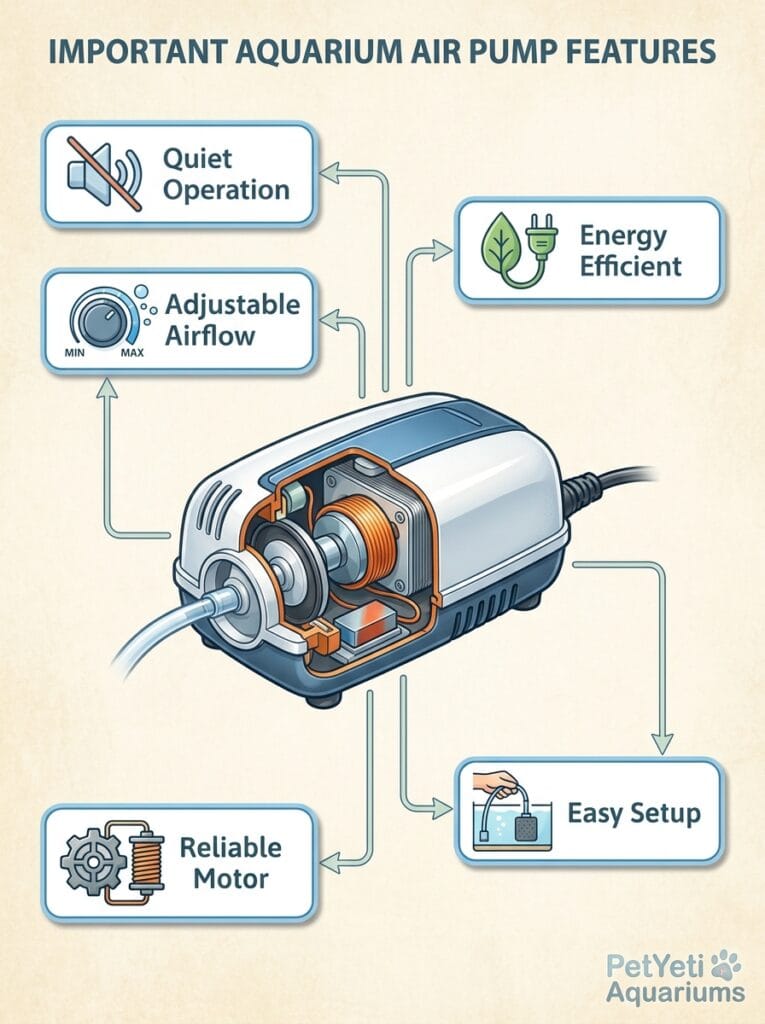
Features Beginners Should Look For
You don’t need the most expensive air pump for a beginner aquarium. Focus on the features that match how you actually plan to use it.
Features Worth Prioritizing
- Suitable airflow — enough for the sponge filter, air stone, or other equipment you plan to run.
- Appropriate pressure — especially important for deeper aquariums or fine-pore air stones.
- Adjustable airflow — useful when you need to reduce bubbling or water movement.
- Noise control — important for bedrooms, desks, and living spaces.
- Multiple outlets — useful if you want to run more than one air-powered device.
- Simple maintenance — a straightforward design is usually easier for beginners to live with.
Don’t Pay for Features You Won’t Use
A dual-outlet pump isn’t necessarily better than a single-outlet pump if you only need to run one sponge filter.
Likewise, maximum airflow isn’t an advantage if it creates more water movement than your fish or equipment needs.
Choose the pump based on the job it needs to perform, not the longest feature list.
PetYeti Tip
If you’re buying an air pump for a bedroom or home-office aquarium, prioritize manageable noise and vibration alongside airflow and pressure.
Quiet vs Loud Air Pumps
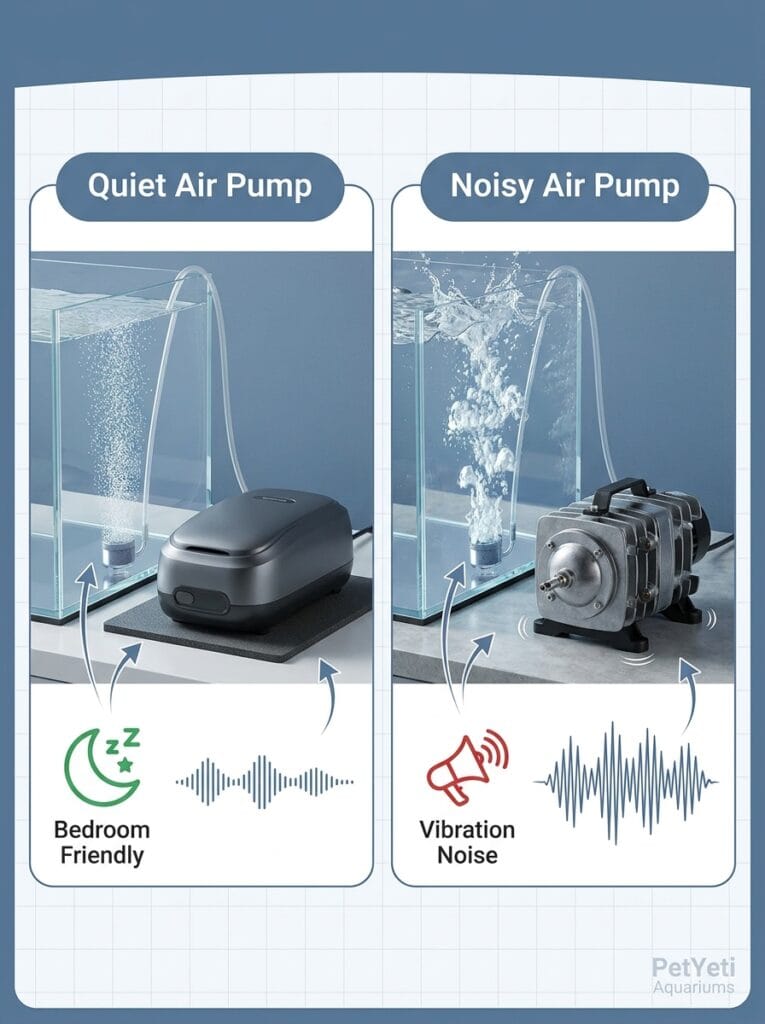
Noise is one of the most common complaints beginners have about air pumps, but the pump itself isn’t always the only source of sound.
Common Sources of Noise
- Motor or pump vibration
- Airflow restriction
- Poor placement
- Air stone noise
- Tubing vibration
- Bubbles breaking at the water surface
Simple Noise-Reduction Tips
- Place the pump on a soft, stable surface.
- Avoid sharply kinked or restricted airline tubing.
- Clean or replace clogged air stones when necessary.
- Keep tubing connections secure.
- Use a check valve when the pump is positioned below or near the aquarium water level.
- Reduce the airflow if the setup is producing more bubbling than necessary.
A pump that sounds loud on a hard aquarium stand may be noticeably quieter when vibration is isolated with a suitable soft pad.
PetYeti Tip
For a bedroom or home-office aquarium, prioritize manageable noise and vibration rather than simply buying the most powerful pump.
Helpful Safety Addition: Aquarium Check Valve
A check valve is a small component installed in the airline tubing that helps prevent water from flowing backward toward the air pump if the pump stops.
Why We Like It:
✓ Helps reduce the risk of back-siphoning
✓ Inexpensive addition to an air-powered setup
✓ Simple to install
PetYeti Take:
A check valve is a small piece of equipment, but it is worth considering whenever your airline setup could allow water to travel back toward the pump.
Common Air Pump Mistakes
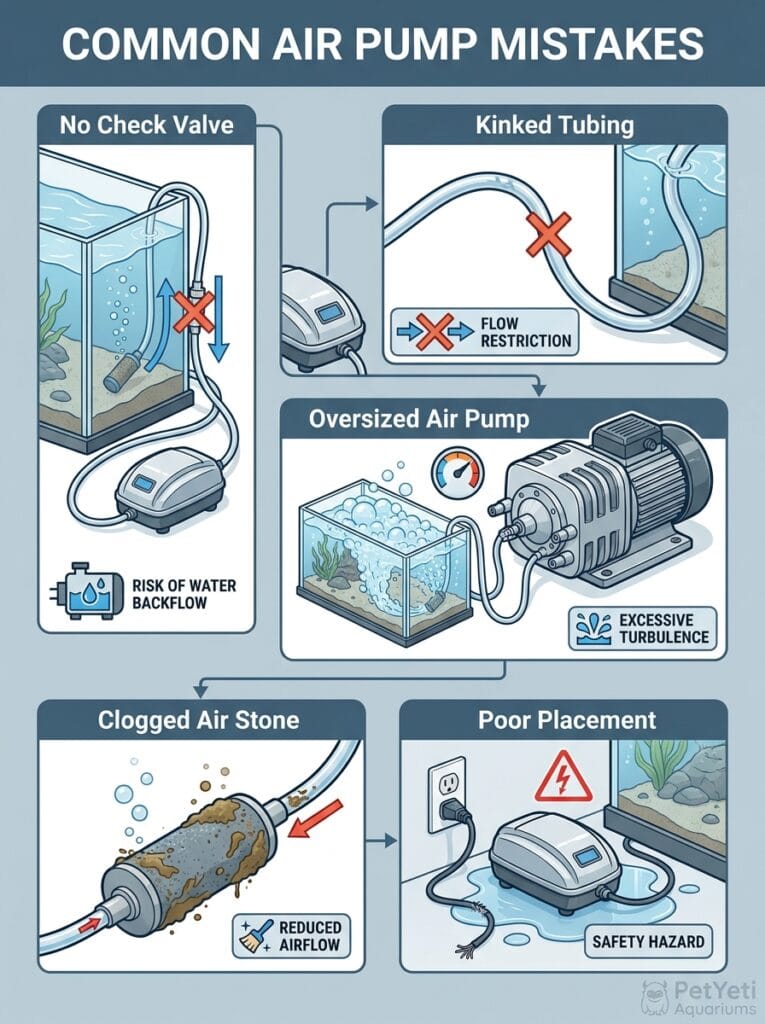
Air pumps are simple devices, but a few common mistakes can make them noisier or less effective than they need to be.
Choosing More Airflow Than You Need
More bubbles aren’t automatically better.
An oversized pump can create excessive surface movement and current, particularly in a small aquarium or with fish that prefer calmer water.
Forgetting a Check Valve
If the pump is positioned below the aquarium water level, water can potentially travel backward through the airline tubing when the pump stops.
A check valve helps reduce this risk.
Using a Clogged Air Stone
Air stones can accumulate debris and mineral deposits over time.
If bubbling becomes noticeably weaker, inspect the air stone and airline tubing before assuming the pump has failed.
Ignoring Pump Vibration
A pump sitting directly on a hard surface can transfer vibration into the aquarium stand.
A suitable soft pad or other vibration-isolating surface can help reduce this noise.
Assuming Bubbles Are the Goal
The goal isn’t to produce as many bubbles as possible.
What matters is appropriate water movement and gas exchange for your particular aquarium.
What to Remember
Choose enough airflow for the equipment you’re running, then adjust it to suit the aquarium rather than simply maximizing the bubbles.
Don’t Forget the Airline Tubing
An air pump is only part of the setup. You’ll also need suitable airline tubing to connect the pump to your sponge filter, air stone, or other air-powered equipment.
When choosing tubing:
- Make sure it fits the connections on your equipment.
- Keep the tubing reasonably short and free of unnecessary bends.
- Avoid sharp kinks that restrict airflow.
- Use a check valve when appropriate for the pump’s position.
You don’t need anything complicated. The tubing simply needs to provide a secure path for air from the pump to the aquarium equipment.
Helpful Add-On: Airline Tubing Kit.
Best For: ✓ Sponge filters
✓ Air stones
✓ New aquarium setups
PetYeti Take:
Many beginners forget that air-powered equipment also needs tubing, so it helps to have extra available during setup.
👉 Check Current Price
Related PetYeti Guides
If you’re deciding whether an air pump is right for your aquarium, these guides can help with the next step:
- Do Aquarium Air Stones Really Help? — Understand what air stones actually do and when they can be useful.
- Best Aquarium Air Stones for Beginners — Compare air-stone options for different setups.
- Best Aquarium Filters for Beginners — Start here if you’re still choosing your main filtration system.
- Sponge Filter vs HOB Filter — Compare two common beginner filtration options.
- Quiet Aquarium Filters — Useful if aquarium noise is one of your main concerns.
- How to Test Aquarium Water Correctly — Learn how to monitor your aquarium’s water conditions.
These guides cover the equipment choices that most often come up alongside an aquarium air pump, so you can choose only what your particular setup actually needs.
CONCLUSION
Choosing the best aquarium air pump is less about buying the most powerful model and more about matching the pump to what your aquarium actually needs.
For a small desktop, betta, or nano aquarium, a compact pump can be a practical choice when you need to run a sponge filter or air stone. For a larger aquarium or multiple air-powered devices, a stronger pump with adjustable airflow and multiple outlets may make more sense.
Before buying, consider:
- What you want the pump to run
- The size and depth of your aquarium
- How much airflow you actually need
- Noise and vibration, especially in bedrooms or home offices
- Whether you need adjustable airflow or multiple outlets
- The tubing, air stone, sponge filter, and check valve you’ll also need
And remember: not every aquarium needs an air pump. If your existing filter already provides adequate surface movement and gas exchange, an additional pump may be unnecessary.
The best air pump is the one that gives your aquarium the aeration it needs without adding unnecessary noise, equipment, or complexity.
Best Choice for Beginners
If you want a reliable, quiet air pump for a small or medium tank, start with the Hygger Silent Mini Air Pump for desktop setups under 15 gallons or the Tetra Whisper Air Pump for 10-to-40 gallon community tanks. Both options make adding gentle oxygen and driving sponge filters completely hassle-free.
FAQs
Do all fish tanks need an air pump?
No. Many aquariums get adequate gas exchange from their existing filter and normal surface movement. An air pump becomes useful when you need to run equipment such as a sponge filter or air stone, or when additional surface agitation is helpful.
Does an air pump add oxygen to the water?
Mostly indirectly. The bubbles disturb the water surface, increasing gas exchange between the water and air. The resulting surface movement is more important than the bubbles themselves.
Can fish survive without an air pump?
Yes. Many healthy aquariums operate without a separate air pump when filtration provides adequate circulation and surface agitation.
Do I need an air pump for a sponge filter?
Usually, yes. Most sponge filters rely on an air pump to create the water movement that pulls aquarium water through the sponge.
How long should an aquarium air pump run?
If the pump is being used for continuous aeration or to operate a sponge filter, it is generally intended to run continuously. Follow the manufacturer’s instructions for your specific pump.
Can an air pump stress fish?
It can if the resulting water movement is excessive for the fish. If the aquarium becomes too turbulent, reduce the airflow or use an adjustable pump or air valve.
How do I make an aquarium air pump quieter?
Place the pump on a soft, stable surface to reduce vibration, avoid kinked tubing, keep connections secure, and check that the air stone is not clogged. The pump’s own design also affects noise.
Do I need a check valve for an aquarium air pump?
A check valve is a useful safety addition when the pump is positioned below or near the aquarium water level. It helps prevent water from flowing backward through the airline if the pump stops.
Is a more powerful aquarium air pump better?
Not necessarily. Excessive airflow can create unnecessary noise and water movement. Choose enough airflow and pressure for the equipment you’re running rather than simply buying the strongest pump available.
How do I choose an air pump for my aquarium?
Start with the job the pump needs to perform, then consider aquarium size and depth, required airflow and pressure, noise, adjustable flow, and the number of devices you want to run. Always check the manufacturer’s specifications for the specific model.