
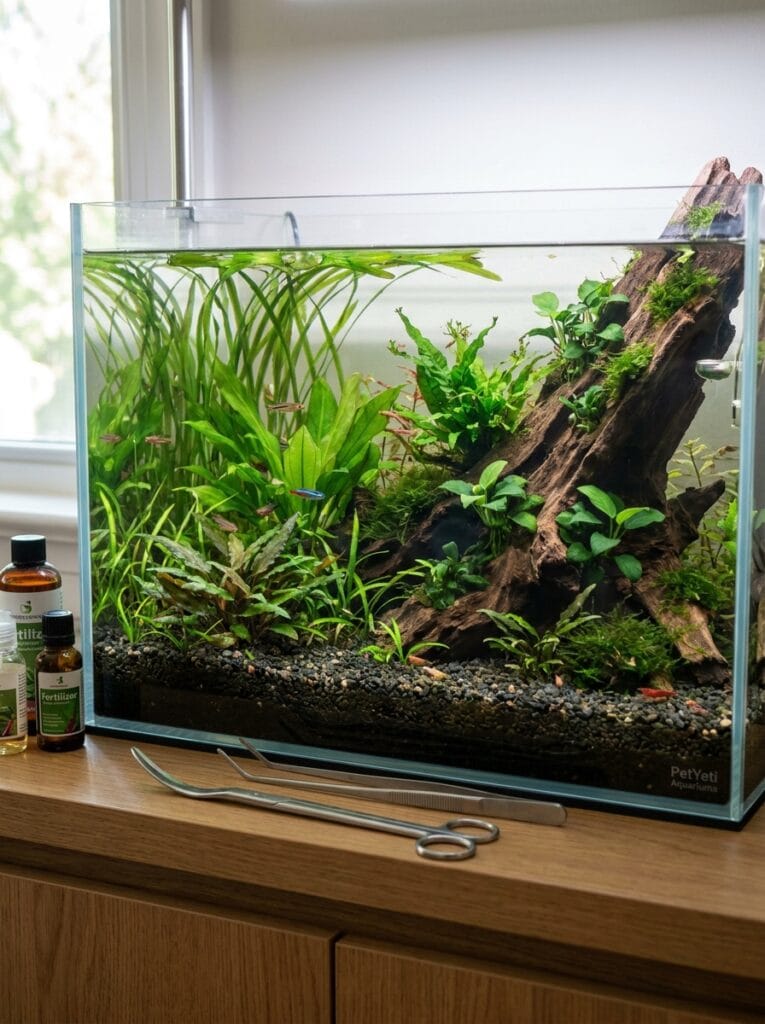
Once aquarium hobbyists discover that plants sometimes need nutrients, the next question usually follows quickly:
Should I use root tabs or liquid fertilizer?
At first glance, they seem to do the same thing.
Both provide nutrients.
Both support plant growth.
Both can improve plant health.
But they work in very different ways.
Using the wrong type of fertilizer won’t necessarily harm your plants, but it may not solve the problem you’re trying to fix.
In this guide, we’ll compare root tabs and liquid fertilizer, explain when each one works best, and help you determine which approach makes the most sense for your aquarium.
- What Are Root Tabs?
- What Is Liquid Fertilizer?
- The Biggest Difference Between Root Tabs and Liquid Fertilizer
- Which Plants Benefit Most From Root Tabs?
- Which Plants Benefit Most From Liquid Fertilizer?
- Can You Use Root Tabs and Liquid Fertilizer Together?
- Root Tabs vs Liquid Fertilizer Quick Decision Table
- Common Fertilizer Mistakes Beginners Make
- Which Option Is Better for Beginners?
- CONCLUSION
- FAQs
As an Amazon Associate, PetYeti earns from qualifying purchases. This comes at no additional cost to you and helps support the site. We only recommend products we genuinely believe can help create healthier and more enjoyable aquariums.
What Are Root Tabs?
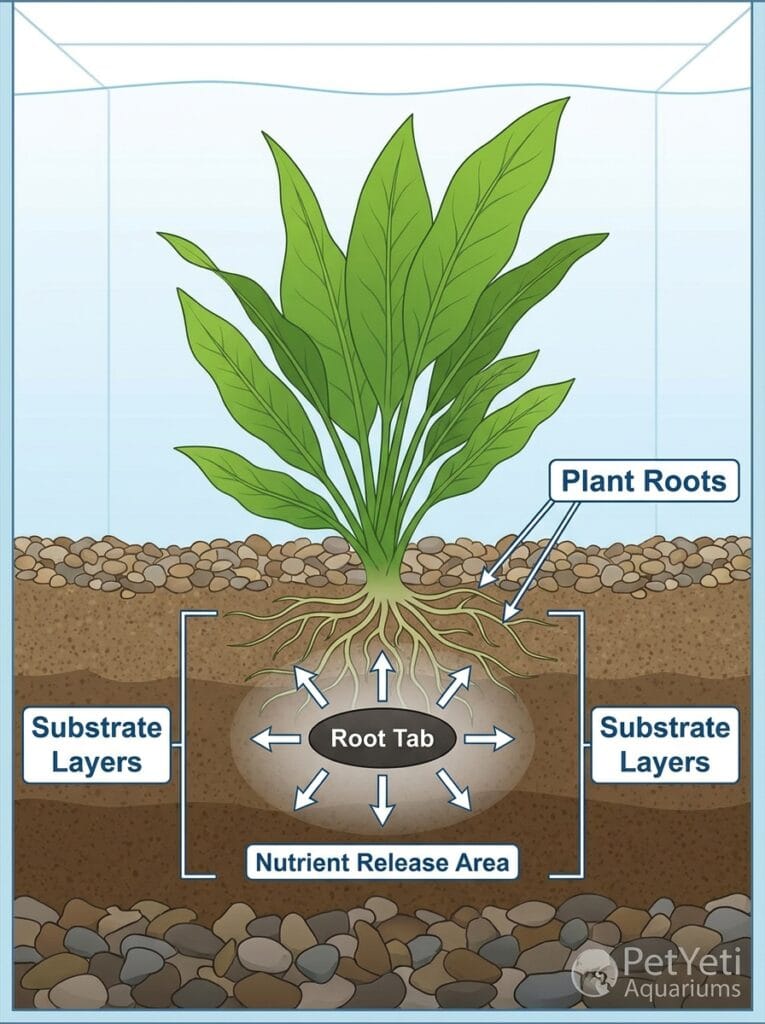
Root tabs are concentrated nutrient capsules or tablets that are inserted directly into the aquarium substrate.
Once placed beneath the substrate, they slowly release nutrients near plant roots.
Think of them as underground fertilizer.
The nutrients stay close to the root system where certain plants can access them efficiently.
Root Tabs Are Commonly Used For
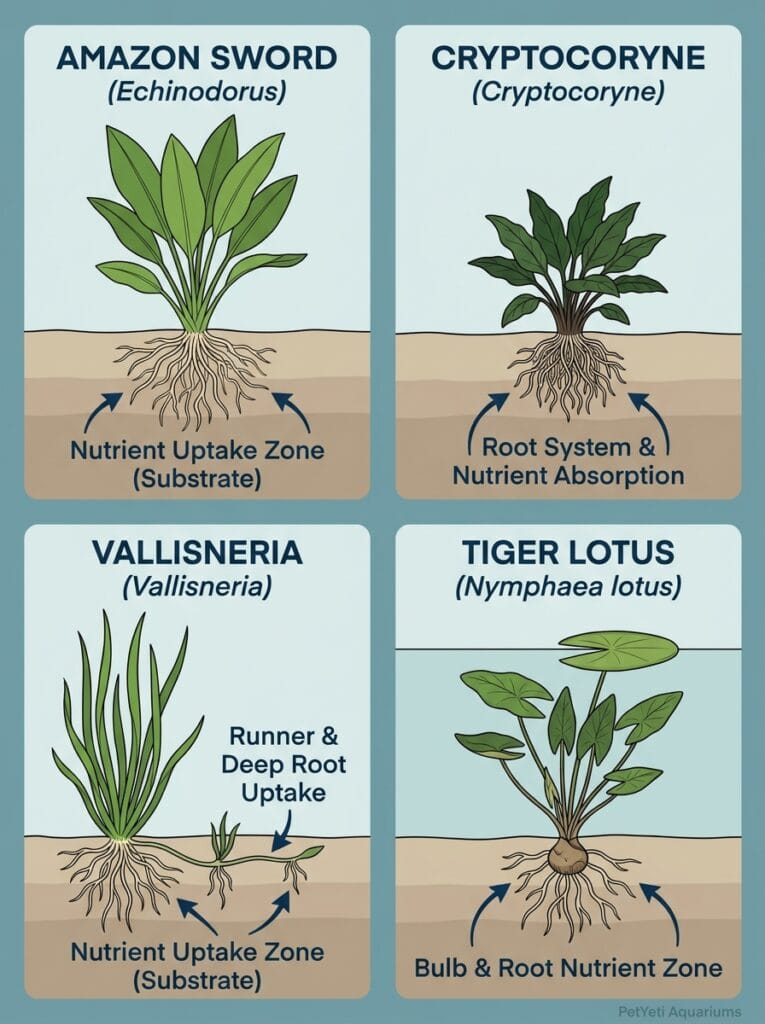
- Amazon Swords
- Cryptocoryne species
- Vallisneria
- Tiger Lotus
- Other root-feeding plants
Real-Life Example
An Amazon Sword may look healthy initially after purchase but begin slowing down several weeks later. In many cases, the plant has exhausted available nutrients in the substrate and benefits from root tab supplementation.
Why They Work
Root tabs place nutrients exactly where root-feeding plants naturally prefer to absorb them.
⭐ PetYeti Pick: Root-Feeding Plant Support
Recommended Option: Aquarium Root Tabs
Best For:
✓ Amazon Swords
✓ Cryptocoryne
✓ Vallisneria
✓ Tiger Lotus
✓ Gravel or sand aquariums with root-feeding plants
Why We Like It:
✓ Places nutrients near plant roots
✓ Useful for heavy root feeders
✓ Beginner-friendly
✓ Helps support planted tanks without complicated dosing
PetYeti Take:
Root tabs make the most sense when your aquarium plants feed heavily through the substrate. If your tank has Amazon Swords, Cryptocoryne, or similar root-feeding plants, this is usually the fertilizer type we would consider first.
What Is Liquid Fertilizer?
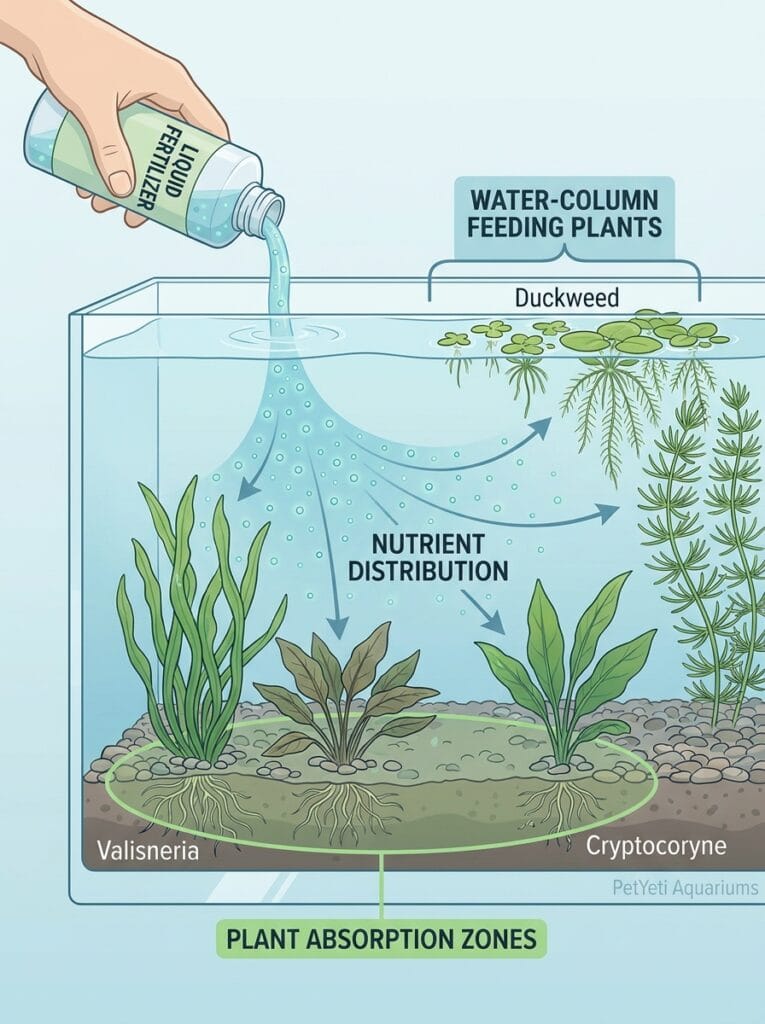
Liquid fertilizer works differently.
Instead of feeding the substrate, it adds nutrients directly to the water column.
Plants absorb these nutrients through their leaves and exposed surfaces.
This makes liquid fertilizer especially useful for species that don’t rely heavily on root systems.
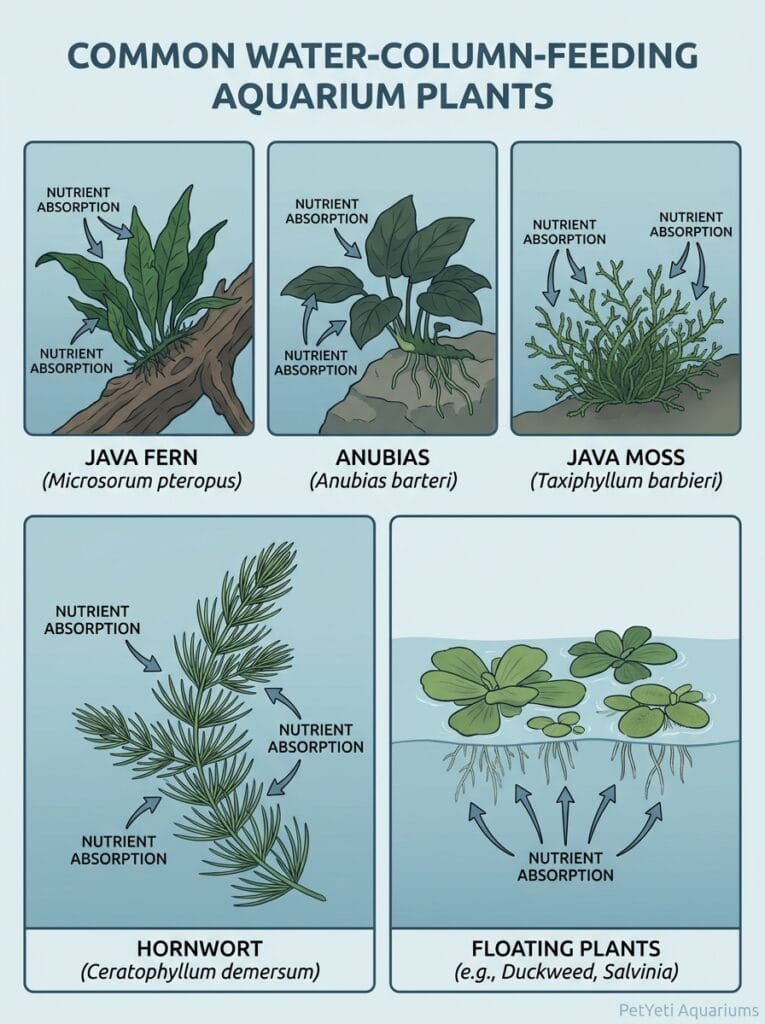
Common Water-Column Feeders
- Java Fern
- Anubias
- Java Moss
- Hornwort
- Floating Plants
Real-Life Example
A hobbyist using only root tabs may notice little improvement in Anubias growth because the plant primarily absorbs nutrients through its leaves rather than its roots.
Why It Works
Liquid fertilizer distributes nutrients throughout the aquarium where water-column-feeding plants can easily access them.
Helpful Plant Growth Option
Recommended Option: Beginner Liquid Aquarium Fertilizer
Best For:
✓ Java Fern
✓ Anubias
✓ Java Moss
✓ Hornwort
✓ Floating plants
✓ Driftwood or rock-attached plants
Why We Like It:
✓ Supports water-column-feeding plants
✓ Easy to dose
✓ Useful for low-tech planted aquariums
✓ Works well for beginner-friendly plants
PetYeti Take:
Liquid fertilizer is often the better fit when your plants absorb nutrients from the water instead of the substrate. For plants like Anubias, Java Fern, mosses, and floating plants, this is usually the more practical starting point.
The Biggest Difference Between Root Tabs and Liquid Fertilizer
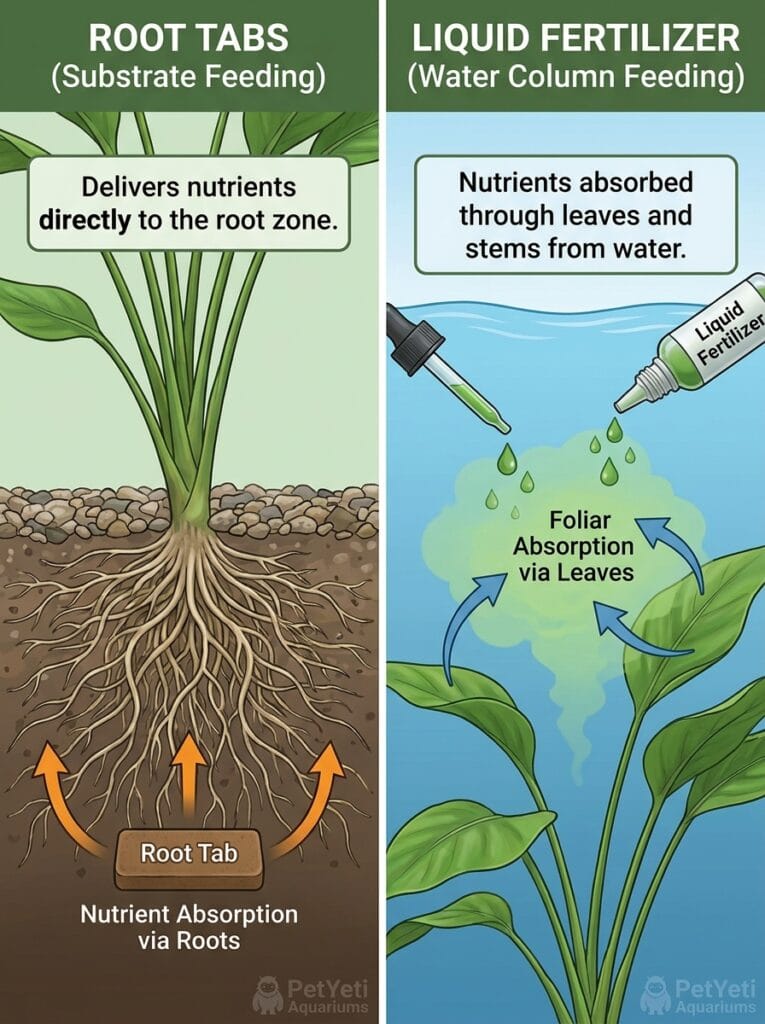
The biggest difference comes down to where the nutrients are delivered.
| Fertilizer Type | Primary Delivery Method |
|---|---|
| Root Tabs | Through the substrate |
| Liquid Fertilizer | Through the water column |
That sounds simple, but it’s one of the most important concepts in planted aquarium care.
Quick Rule
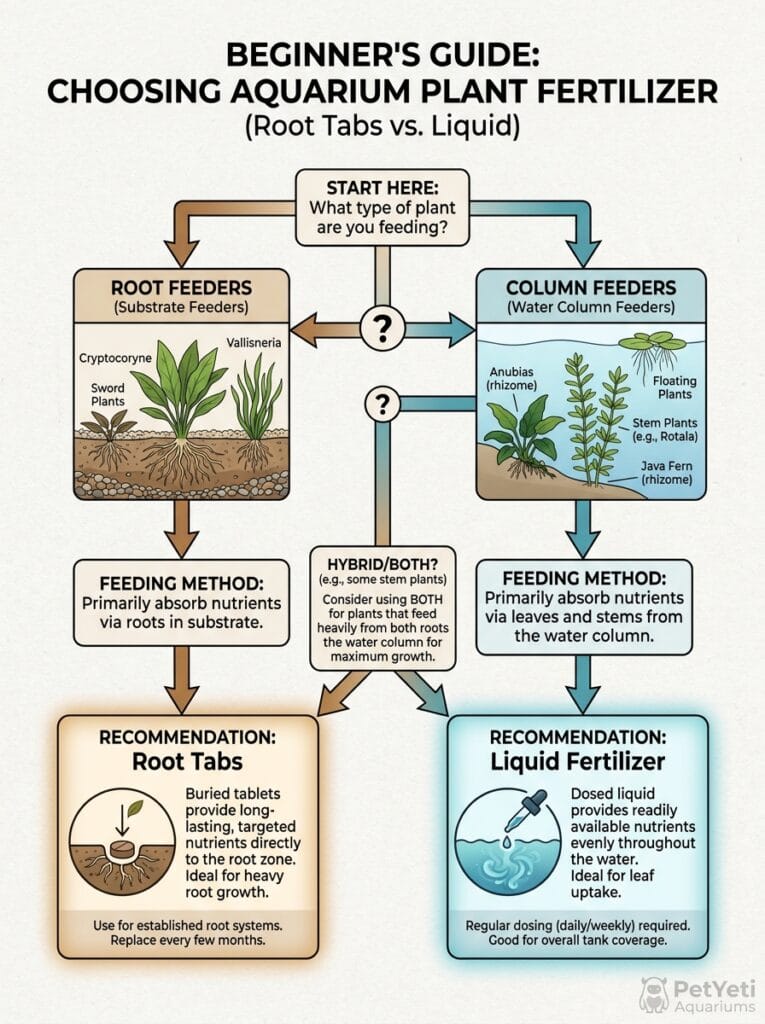
If the plant primarily feeds through roots:
➡ Root tabs are often beneficial.
If the plant primarily feeds through leaves:
➡ Liquid fertilizer is often more useful.
Real-Life Example
Many beginners assume one fertilizer works for every plant. In reality, different species evolved to gather nutrients in different ways.
What to Expect
Once you match the fertilizer type to the plant’s feeding style, growth often improves significantly.
Which Plants Benefit Most From Root Tabs?
Some aquarium plants are often called “heavy root feeders.”
These plants pull a large portion of their nutrients directly from the substrate.
Strong Root Feeders
| Plant | Root Tab Benefit |
|---|---|
| Amazon Sword | ★★★★★ |
| Cryptocoryne | ★★★★★ |
| Vallisneria | ★★★★☆ |
| Tiger Lotus | ★★★★★ |
Real-Life Example
An Amazon Sword grown in plain gravel frequently responds dramatically after root tabs are added because nutrients become available exactly where the plant needs them most.
Which Plants Benefit Most From Liquid Fertilizer?
Many popular aquarium plants absorb most of their nutrients directly from the water.
For these plants, liquid fertilizer is often more effective than root tabs.
This is especially true for plants attached to rocks, driftwood, or decorations because their roots are not buried in nutrient-rich substrate.
Common Water-Column Feeders
| Plant | Liquid Fertilizer Benefit |
|---|---|
| Java Fern | ★★★★★ |
| Anubias | ★★★★★ |
| Java Moss | ★★★★★ |
| Hornwort | ★★★★★ |
| Floating Plants | ★★★★★ |
Real-Life Example
An aquarium owner may add root tabs beneath an Anubias plant and see little improvement because the plant is attached to driftwood. In this case, liquid fertilizer often provides much better results.
Why This Matters
Choosing the correct fertilizer method can save both money and frustration.
Can You Use Root Tabs and Liquid Fertilizer Together?
Absolutely.
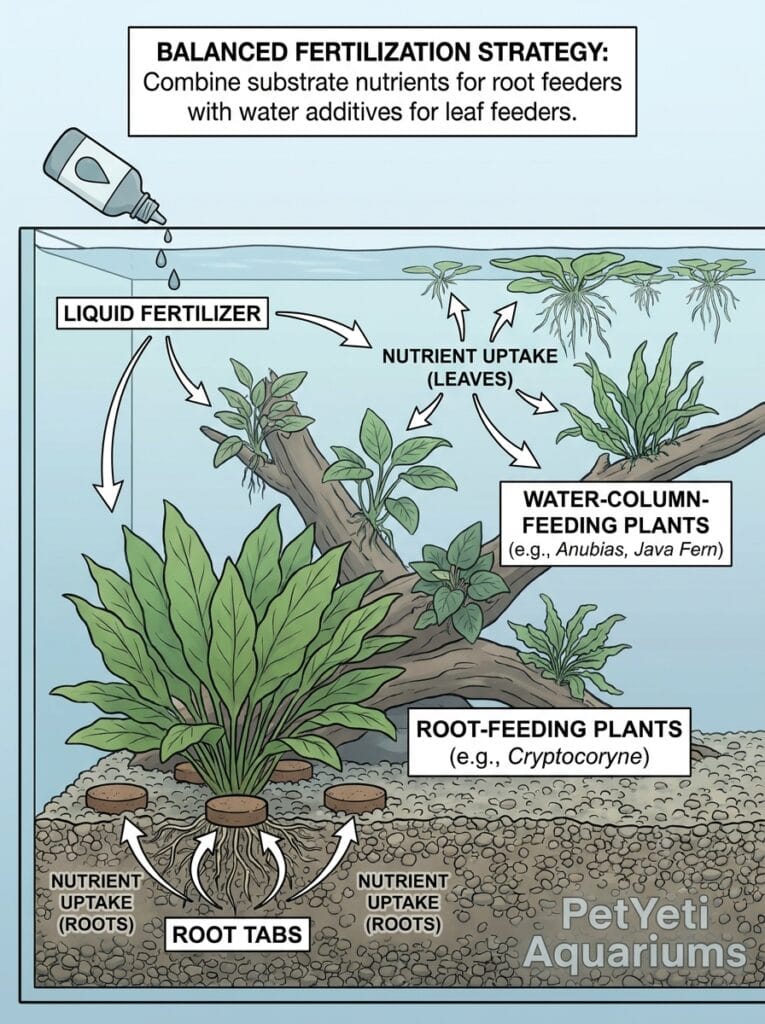
In fact, many successful planted aquariums use both.
The reason is simple:
Most aquariums contain different types of plants.
Some prefer nutrients at their roots.
Others prefer nutrients from the water column.
Example Setup
| Plant | Preferred Fertilization |
|---|---|
| Amazon Sword | Root Tabs |
| Cryptocoryne | Root Tabs |
| Java Fern | Liquid Fertilizer |
| Anubias | Liquid Fertilizer |
| Floating Plants | Liquid Fertilizer |
Real-Life Example
A planted community aquarium may contain Amazon Swords in the substrate and Anubias attached to driftwood. Using both fertilization methods allows each plant to receive nutrients in the way it naturally prefers.
PetYeti Tip
If your aquarium contains a variety of plants, a combination approach often produces the most balanced results.
Root Tabs vs Liquid Fertilizer Quick Decision Table
If you’re unsure which fertilizer to choose, this table can help.
| Situation | Best Choice |
|---|---|
| Mostly Amazon Swords and Crypts | Root Tabs |
| Mostly Anubias and Java Fern | Liquid Fertilizer |
| Floating Plant Aquarium | Liquid Fertilizer |
| Heavily Planted Mixed Aquarium | Both |
| Gravel Substrate with Root Feeders | Root Tabs |
| Driftwood Plant Setup | Liquid Fertilizer |
Real-Life Example
Many beginners start with liquid fertilizer because it feels simpler. As their plant collection expands, they often discover that certain species benefit from additional root nutrition.
What to Expect
The more diverse your planted aquarium becomes, the more likely you’ll eventually use both methods.
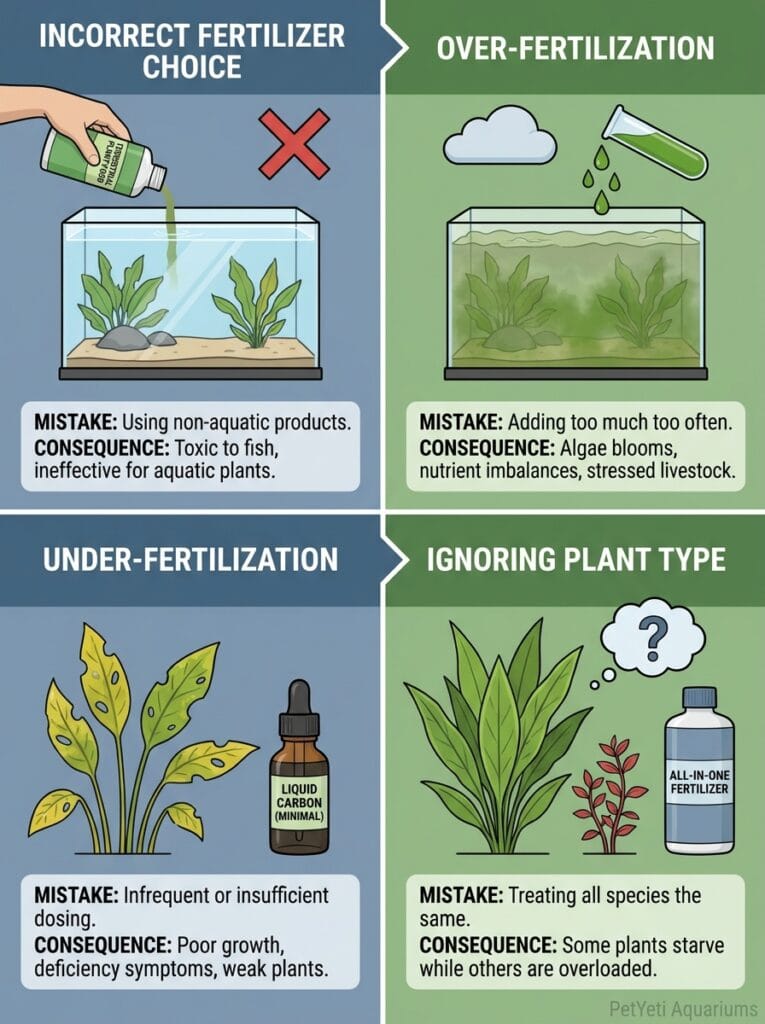
Common Fertilizer Mistakes Beginners Make
Many plant problems aren’t caused by the fertilizer itself.
They’re caused by using the wrong fertilizer for the situation.
Common Mistakes
❌ Using root tabs for plants attached to driftwood
❌ Expecting root tabs to feed floating plants
❌ Assuming one fertilizer works for every plant
❌ Adding excessive fertilizer to fix slow growth
❌ Ignoring lighting and plant requirements
❌ Making multiple changes at the same time
Real-Life Example
A hobbyist noticed slow plant growth and immediately increased fertilizer dosage. The real problem turned out to be inadequate lighting, not a nutrient deficiency.
Why This Matters
Fertilizer is only one piece of the puzzle.
Healthy growth depends on balancing nutrients, lighting, plant selection, and patience.
Which Option Is Better for Beginners?
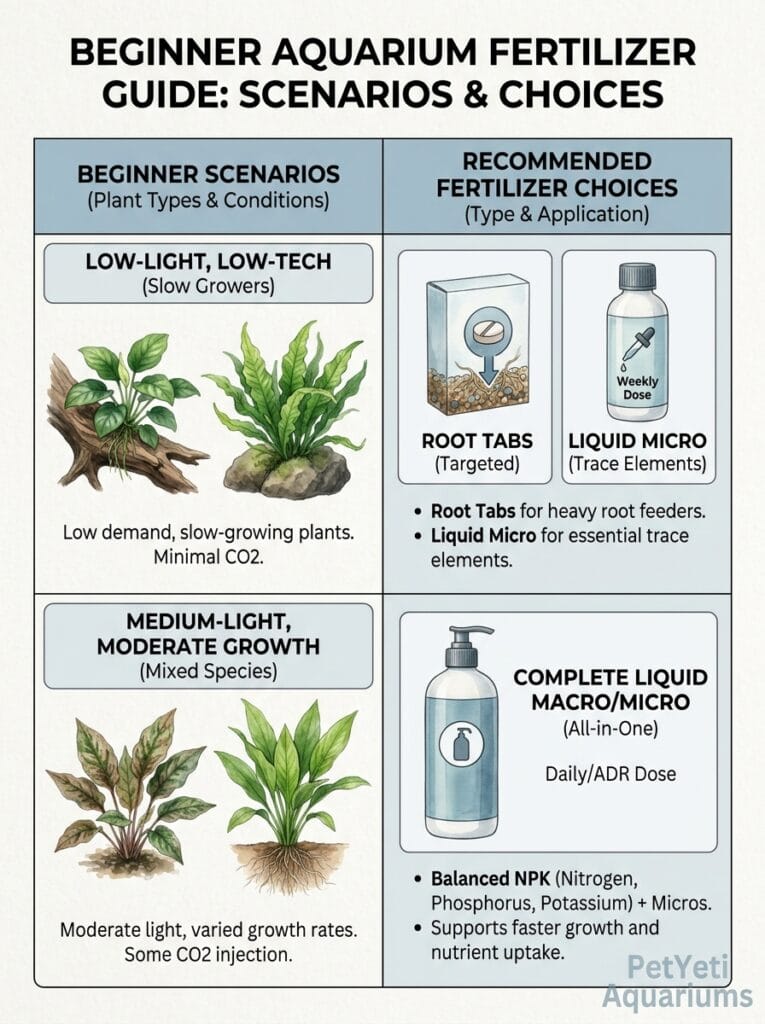
The answer depends on the plants you’re growing.
However, for many beginners:
If You Mainly Keep
- Anubias
- Java Fern
- Java Moss
- Floating Plants
Start with a simple liquid fertilizer.
If You Mainly Keep
- Amazon Swords
- Cryptocoryne
- Vallisneria
Start with root tabs.
If You Keep Both Types
A combined approach usually works best.
PetYeti Recommendation
Don’t buy fertilizers just because someone online says you need them.
Look at the plants you actually have.
Understanding your plants will always produce better results than blindly following a fertilization schedule.
Helpful Next Reads
Choosing between root tabs and liquid fertilizer is easier when you know how your plants feed and what kind of growth problem you are seeing.
Still unsure if fertilizer is needed? Read do aquarium plants need fertilizer.
Yellowing leaves? See why aquarium plants turn yellow.
Brown leaves or weak growth? Read why aquarium plants turn brown.
Keeping easy low-light plants? See our low-light aquarium plants guide.
Planning a planted betta setup? Read our guide to creating a beautiful planted betta tank.
CONCLUSION
The debate between root tabs and liquid fertilizer isn’t really about which product is better.
It’s about matching nutrients to the plants you’re growing.
Root tabs work best for plants that feed heavily through their roots.
Liquid fertilizer works best for plants that absorb nutrients from the water column.
And in many planted aquariums, using both creates the best balance.
The goal isn’t to add more products.
The goal is to provide nutrients where your plants can actually use them.
When you understand how your plants feed, fertilizer decisions become much simpler.
And that leads to healthier growth, fewer problems, and a more beautiful planted aquarium.
FAQs
Are root tabs better than liquid fertilizer?
Neither is universally better. The best choice depends on the type of plants you’re growing.
Can I use root tabs and liquid fertilizer together?
Yes. Many planted aquariums successfully use both methods.
Do Anubias need root tabs?
Usually not. Anubias primarily absorb nutrients from the water column and often benefit more from liquid fertilizer.
Do Amazon Swords need root tabs?
In many aquariums, yes. Amazon Swords are heavy root feeders and often respond well to root tabs.
How often should I replace root tabs?
This varies by product, but many root tabs last several months before needing replacement.
Can too much fertilizer cause algae?
Yes. Excess nutrients can contribute to algae growth if plants cannot use them efficiently.